Hearts and Minds: An Ambivalent Review of “Project Hail Mary”
“I try to be scientifically accurate. That’s my whole shtick.”
—Andy Weir
“You Keep Using That Word. I Do Not Think It Means What You Think It Means.”
—Inigo Montoya
“We don’t need other worlds. We need mirrors.”
—Stanislaw Lem, Solaris
Lers of Spoi.
You Have Been Warned.
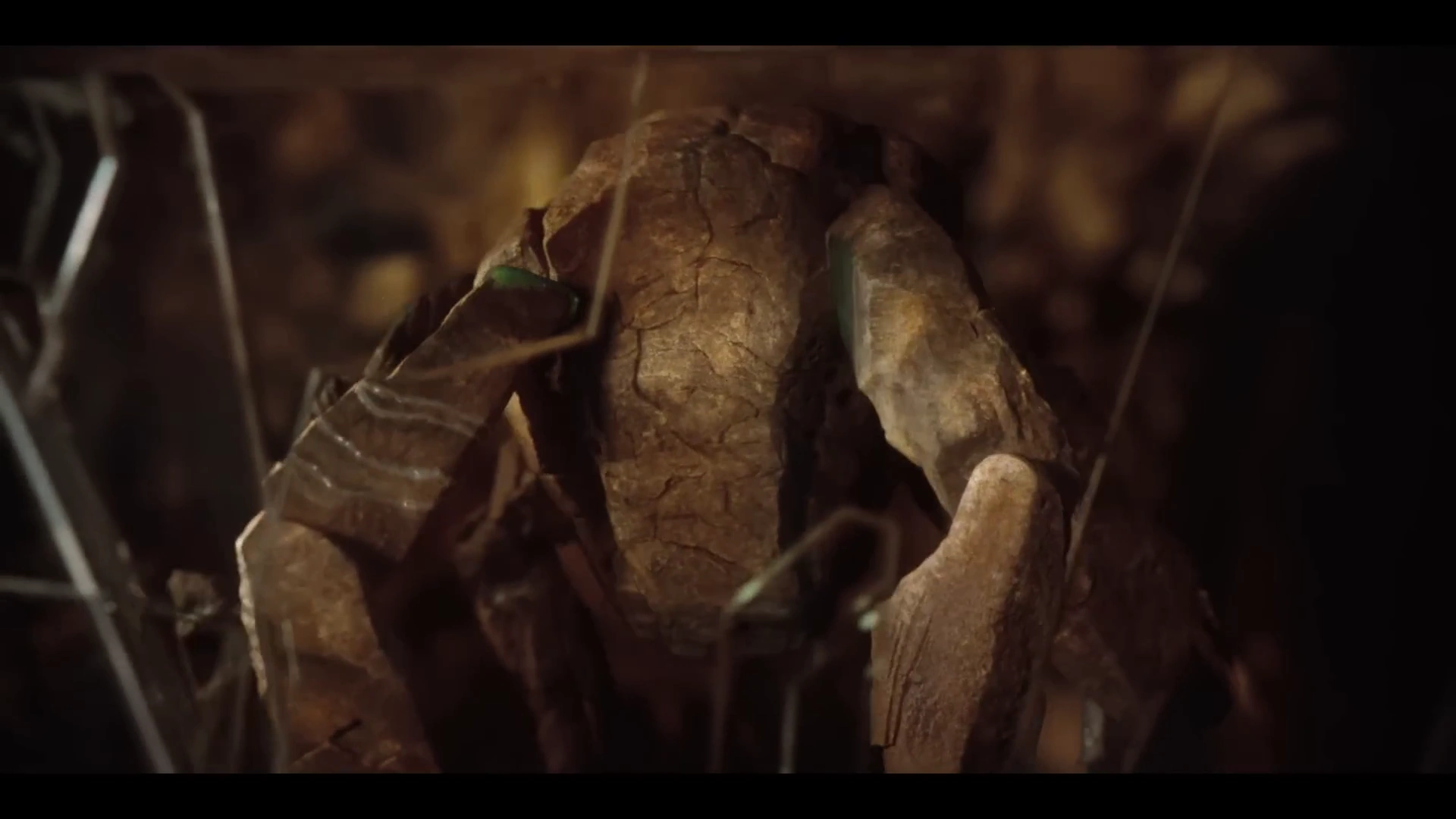
As the credits rolled at the end of “Project Hail Mary”, I turned to the The BUG and said “Well, another story where the alien turns out to be a human in a rubber suit.” The BUG shook her head: “Not a Human. A smart goofy golden retriever.”
We weren’t talking about morphology, of course. We’re decades past the point where movies had to put actors in rubber suits to portray aliens. But intellectually. Psychologically. Rocky—an anaerobic, blind, echolocating smart exoskeleton hosting a colony of alien microbes from Vulcan 40 Eridani—turns out to be just a guy super-smart golden retriever. The vastly different environments of Erid and Earth—the radically different morphologies of the life that evolved on each world—have somehow converged on the same overall personality template. I’ve encountered Republicans with a more alien mindset than Rocky.
I hesitate to admit this, but I actually liked this movie quite a bit the second time I saw it. (The first time, I thought it was the most scientifically-illiterate pro-science polemic I’d ever seen. I calmed down a bit for the rewatch.) It does a number of things very well. The first act nails the sense of isolation, of loneliness in an infinite void. Ryan Ghosling as Ryland Grace is, as always, a sympathetic protagonist. Making him a sniveling coward who has to be dragged kicking and screaming into a suicide mission is a refreshing departure from the usual Hollywood hero who stoically accepts his fate for the sake of Humanity. The music soundtrack works way better than it has any right to. Space is mercifully silent: a small detail, but one that so very few movies have ever bothered to respect. The movie is never boring. It at least pretends to care about science, unapologetically portrays the scientific process as a good thing, something that works, bitches. Christ knows that’s a message that needs as big a megaphone as you can find these days.
The movie also undercuts that position by seemingly regarding its target audience as a bunch of incurious imbeciles who’d rather be coddled than challenged.
Speaking as one of the few modern authors—maybe the only other?[1](nope. Just one of the few)— to have published a story about alien life-forms taking up residence in the sun[2] (right down to consequent Earthly perils due to solar cooling), I feel at least partially qualified to weigh in on the movie even though I haven’t read the novel. I have, at least, gone down a variety of rabbit holes exploring the scientific underpinnings of Project Hail Mary (we cite the novel using italics; when talking about the movie, “quotes”). I have read/watched pieces both gushing and dispassionate, ranging from the credible (a piece in the New York Times) to the sloppy (a “A PhD-Level Breakdown of Every Organism, Equation, Material, Scene, and Production Decision”, which appears to have been written by an LLM). I have a sense of which elements from Project Hail Mary made it into “Project Hail Mary”, and—more tellingly—which ones didn’t.
Movie first. Consider the main driver of the plot: a microbe composed “almost entirely of water” whose natural habitat is—wait for it—the surface of the sun. Also the atmosphere of Venus; it actively navigates between the two in the kind of ongoing feeding-ground/breeding-ground migration you’d see in humpback whales. (Hell, for all we know it lives on humpback whales too; the movie has the little buggers bopping around on Earth without any trouble.)
The movie recognizes the fundamental absurdity of this. Grace is recruited to the Hail Mary project because of his theories about non-water-based life, which the alien microbe clearly must be because “It lives on the surface of the sun. Does that sound like a water-based life form to you?” Soon enough we discover that astrophage is, in fact, water-based. Which should, as the movie has already acknowledged, be absolutely impossible for a denizen of the solar photosphere.
The movie never acknowledges the paradox. The whole question of how an astrophage can live where it does is never answered, never even mentioned again.
They could have answered it. Weir did, in the novel. His answer wasn’t perfect. He pulls something called “super cross-sectionality” out of his ass: a property that, instantiated in a cell membrane, traps neutrinos (which can then be harnessed as an endogenous power source and heat sink) and which is “opaque to all radiation”. Super-cross-sectionality is the secret sauce that allows astrophages to stay just below the boiling point of water no matter where they are.
Given that your average neutrino can’t be bothered to even notice when it’s passing through the mass of an entire planet, we’re clearly talking one magical membrane here, and you know what? I’ll give him that, even though the premise makes as much sense as saying Hey, these flatworms are just like the ones we have on Earth except they evolved with microscopic fusion reactors inside ’em. SF is full of things that don’t exist (or at least, haven’t been discovered yet) in service of a good story. Intrinsic fields. Warp cores and jump gates. Alderson drives. Hell, I’m probably gonna pull some kind of fictitious particle out of my own ass to keep the Sunflowers stories consistent (if any of the cosmologists I’ve reached out to ever get back to me, that is).
Now, once you’ve invented new rules—no matter how batshit—you’re obligated to follow them, at least if you purport to be writing “Hard SF”. That’s the point of the whole exercise: posit a scenario, play out the logical consequences. If astrophages are opaque to all forms of radiation, then they’re perfectly shielded; which is to say, they’re perfectly blind. There’s no way to navigate to Venus without opening the windows at least a crack, and the moment you do that anywhere near the sun you’re (very badly burned) toast. The same miracle that enables one facet of astrophage biology excludes another.
Again: I’ve not read the novel. It’s possible that Weir had an answer to that too, one the essays and videos I’ve digested simply didn’t mention. But even if he did screw that particular pooch, at least the dude put some thought into it. Not a great solution, but at least the problem wasn’t completely ignored in the book.
So, having already highlighted the issue in the screenplay, the producers could have spared a line or two of dialog to slot in Weir’s solution. Apparently, though, questions like Wait a second…how does a eukaryotic cell survive on the surface of the sun? were considered too trivial, too irrelevant, to warrant mention in the adaptation. The audience won’t care, the studio seemed to be thinking. The audience will be bored. The audience is too dumb to even ask the question.
And the studio was right. I’ve read no shortage of raves about “Project Hail Mary”. Many of them focus on how accurate its science is; Weir himself has spoken often and at length about the research he did, the equations he solved, how very rigorous the whole production is. There’s a market for intelligent hard science fiction, people are saying. We’re not niche any more. “PHM” proves it.
I beg to differ.
I could witter on about this or that technical error showing that “PHM”’s producers didn’t do their Hard-SF homework (How can Rocky parse videos on a flatscreen when its echolocation needs 3D topography to bounce off? How can the Hail Mary make it past 90% lightspeed when blueshift ablation would have melted the whole ship to slag at less than half that speed? How could Grace plot an intercept course to Rocky’s ship without even knowing what masses to scribble on his white board?). But my problem with the movie is more fundamental, more—philosophical—than a list of technical gripes.
Put simply: I don’t think people love this movie because it’s Hard-SF. They love it because it’s comforting. It feels good. And while I don’t have any objection to feel-good movies in principle, “Project Hail Mary” brands itself as far more than that, and I fear the brand suffers as a result.
Which brings us back to Rocky.
Rocky is, biologically, a mindblowingly imaginative creation. I’d put it on a par with the aliens in Adrian Tchaikovsky’s Shroud. Rocky isn’t even the alien itself: the aliens are a specialized, non-sapient metacolony of microbes living within an inorganic chassis that evolved through purely Darwinian processes. Rocky’s brain is the inorganic autopilot in charge of that chassis. Grace is talking to a Waymo, not its passengers (who aren’t even multicellular). This is also a pretty cool way of way of getting around the whole question of how complex multicellularity could have evolved in an anaerobic environment in the first place. It didn’t; all the macrostructures are inorganic. (I wish I’d thought of that when I was writing Blindsight. I could have dispensed with the whole they sprint their whole lives shtick.)
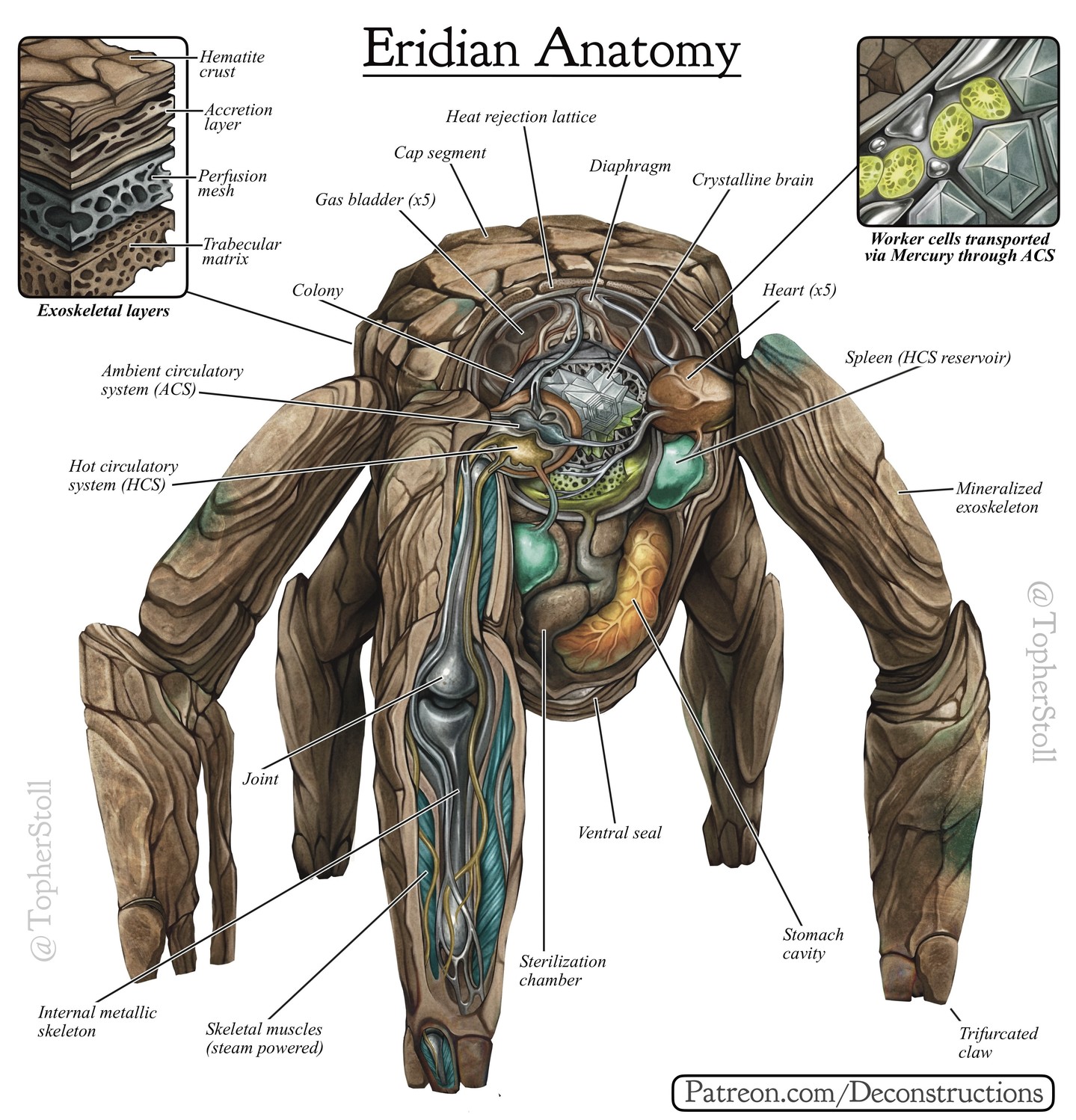
Imagine such an entity: product of an environment so corrosive, so hyperbaric, that xenon can be forged into metal. A powered faceless exoskeleton with mercury for blood and two independent circulatory systems, that perceives reality through sonar and magnetic fields. Radially symmetrical, so no sense of forward/backward, right or left. Egg-laying predatory hermaphrodite. Dual musculatures: one piezoelectric, one that runs off thermal gradients, both of which shut down entirely during dormancy. A crystalline optical computer for a brain. Blind to all EM; unaware even of the existence of light. These are but a few of an Eridian’s truly alien characteristics.
Now try to imagine the cognitive reality emerging from such an entity. Give me your best odds that such a mindset would converge on “friendly golden retriever”.
If I were to go the Hard-SF route— posit the scenario, interrogate the consequences— I’d wonder whether Rocky would even be sane by the time the Hail Mary coasted into orbit. One of the least alien aspects of Erid biology is the complete paralysis they undergo while asleep; they’re profoundly vulnerable to predators/enemies at such times, and can’t simply wake up at the first unexpected noise. So they are compelled to sleep communally, at least one Eridian always on watch while others are dormant. This would be baked into their very natures for as long as they’ve existed as a species: you do not, you cannot sleep alone. And yet Rocky is the sole survivor of a mission gone catastrophically pear-shaped; it could have been forced to sleep unguarded for months, years, before company arrived. What would that do to a being whose fundamental species hardwiring equates solitary sleeping with mortal danger? Rocky would be traumatized at the very least, suffering some kind of nervous breakdown. Rocky could be insane—downright psychotic—before the movie even started. That’s just one small ramification of Weir’s premise to get you started. Others are left as an exercise for the reader.
“Project Hail Mary” is not bad by any means. As I say, I enjoyed it. And if it was just being pitched as a light-hearted feel-good movie I’d just say, go with it. Mission accomplished. But that’s not how it’s being pimped. It’s being described as smart, rigorous, hard SF. Its rigor and empiricism gets thrust in our faces—“Built on Solid Science”, “science that either exists today or could exist given the right conditions”, “this story is packed with real science!”—like copies of The Watchtower from those pests that just won’t get the fuck off your doorstep. And sure, I’ll buy the equations are correct. I’ll buy that Weir calculated how many kilotonnes of astrophage was required to get to Tau Ceti, and how much time would dilate en route (even if the ship would have melted at those speeds).
But here’s the thing: while he showed his work, he didn’t follow where it led. We scribbled on the whiteboard; we witnessed the arduous process by which one makes painstaking first contact. We used Science to strip away the mystery, layer by layer, brought ourselves face-to-face with this profoundly alien intelligence, evolved under conditions we could scarcely imagine…
…Only to discover it wasn’t all that alien after all. It was like us in a crab suit. It’s so much like us we get each other’s jokes. It’s so much like us that Eridians have their own fucking elementary schools, where little Eridian younglings jump eagerly up and down with their hands raised, hoping the teacher will call on them…
Science is a powerful tool. It can help us parse the furthest reaches of the universe if we practice it properly. But this story—this paragon of Hard-SF, this bit of a genre that’s defined by looking unflinchingly at a scenario and asking what are the ramifications—has decided that the answer is People Are The Same All Over. “Project Hail Mary” instantiates the famous Lem quote: it claims to be about other worlds, but really it’s just another mirror. It has far more in common with the cozy Chambersesque Waltons-in-Space vibe than it does with Kubrick and Clarke, despite the hordes who keep polishing its Hard-SF credentials.
And I get it. I really do. We want reassurance, we want to think that no matter how alien and threatening something might seem, underneath our differences we can all be friends. I can understand the appeal, especially nowadays. But it rings hollow when we can’t even get along with our own species. It rings hollow when we’re presented with the setup of something so breath-takingly original, only to see it squandered on a Hollywood ending. And to have this held up as some kind of icon of Hard-SF…
…Well, “betrayed” is far too strong a word, especially for a fun movie with such a big heart. But all the people emphasizing the scientific rigor of “Project Hail Mary”, all those praising it as a work of “Hard SF”—I’d argue they’re cheapening the concept, at the very least. The movie’s carapace is Hard enough, to be sure. But look inside, and the really Hard questions go unexplored.
And this is coming from someone who’s publicly expressed misgivings about whether the very concept of Hard-SF has much functional utility in the first place.
Make of that what you will.
Yeah, I know about Clarke. But that story was about native solar life, not invasive. Also Clarke’s story had no solar-cooling shtick. ↑
“Defective”, in the Lasksa Media/European Astrobiology Institute coproduction Life Beyond Us. Also forthcoming in Fold Catastrophes. ↑








I avoided both the book and film in anticipation of many of the issues you raise. This post rings very similar to the one about the Asian androids film (also avoided). I would love to hear your thoughts on Dragon’s Egg by Robert L. Forward – another work lauded as being super scrupulously researched and plausible, but was possibly the most implausible book I’ve ever read. Instead of humans in a rubber suit, it was humans as flat caterpillars composed of neutronium living on a neutron star, on which time was accelerated by a million times because “nuclear reactions are faster than chemical ones”. I may be wrong, but I don’t think the speed at which things occur on earth are solely constrained by the speed of chemical reactions.
> I avoided both the book and film in anticipation of many of the issues you raise.
If you anticipate the worst in everything, how do you actually choose what to read?
I read a variety of reviews and summaries, both positive and negative. I refer to previous books by the author. I make a judgement. You?
That’s a fair way to approach it.
I read the book, and thought it was fun. The science wasn’t perfect, but when is it? Not every science fiction novel is going to be written by Mr. Watts or Mr. Egan!
The movie definitely dropped a lot of the science bits, but it was already nearly two and a half hours – something had to go, and I think they made the correct decisions for the most part.
If the worst you can anticipate is pretty good, then the real product is bound to be better, yes?
Forward wasn’t completely off in his conception of the cheela in Dragon’s Egg. The cheela weren’t made of neutronium, but degenerate atoms on the surface of a neutron star. In their interiors neutron stars are not pure neutrons, but about 10% protons and electrons, and on the surface normal atomic nuclei could exist. And the speed of biological organisms on Earth is largely determined by the speed of chemical reactions. Protons and neutrons are about 1/64000 the size of a hydrogen atom, so degenerate matter where the nucleons are nearly touching is also comparably smaller and reactions would be faster merely because of the greatly reduced size (electromagnetic interactions could be 64,000 times faster).
Yes, the cheela are unimaginatively very much like humans in their personality and culture, though.
Yeah, as I recall the Cheela even had a Jesus figure…
(Hi Steve! I must get back to the Other Place again.)
… in particular, by the speed of diffusion at ambient temperature in the incredibly jam-packed and busy environment that is the interior of a cell (about 90% complex structures by volume, 10% water, though the water constitutes about 50% of the molecules by count). In particular the driving property is how long it takes for a given enzyme to run into everything else of potential interest inside the cell in its search for its ligands (on the order of a millisecond to a second, depending on the rarity of what you’re looking at: so things that need to interact a lot must be present in great quantity).
(This is one reason why endothermy is good — raising the temperature, but not by so much that proteins start denaturing, speeds everything up.)
My wife took me to see it purely so she could be entertained by me dissecting it and generally ranting like a maniac for the rest of the evening. Glad to see I am in good company.
I’m reminded of Niven’s Known Space stories, which were ram-full of acknowledged violations of all kinds of “fundamental physical law,” which just nodded in acknowledgement of that and posited a special black box for getting around the issue. Not just the FTL hyperdrive, but also the reactionless “thrusters” for navigation inside of star systems, and the artificial gravity that is so cheap it’s built into people’s beds on Earth, and so good it can keep people from getting squashed by 50g acceleration by those “thrusters.” And don’t even get me started on General Products hulls.
Anyway, my point is, there can be a shitload of magical tech in a SF setting and it can be considered legit “Hard SF.” There just has to be some kind of handwaving in acknowledgement that fundamentally new physics was required to get it.
Also the infamous “the Ringworld is unstable!” (a uniform density ring won’t stay centered on its primary under gravity and if it gets off center it will accelerate further off center). Hence the introduction of ring stabilization thrusters in “The Ringworld Engineeers”.
If you run the numbers on tidal forces in the story “Neutron Star” you’d find that poor Beowulf Shaffer would have been torn apart even in his spread-eagle flat position at the center of mass of his ship. Also I’m told that after a close encounter with the neutron star the ship would pick up a lot of angular momentum and come out spinning extremely rapidly, which also would have been bad for Shaffer if he somehow survived the tidal forces at closest approach.
Niven’s a good example here, for different reasons than you suggest. His aliens were alien;hell, his humans were alien, literally. And while the idea that we’re descended from aliens from the galactic core is clearly wrong, Niven took that premise and asked “What are the consequences?”. The question is not whether the premise is accurate; the question is, given the premise, what are the logical ramifications? Niven did that (even with premises that were batshit). Weir, I’d argue, did not.
I think that Niven is also a good example of hard SF, or at least harder SF, because he thinks through the implications of the technology in his settings. For example, in The Mote in God’s Eye (cowritten with Jerry Pournelle), the Langston Field was created so that the spaceships wouldn’t be eggshells armed with hammers, and you can have dramatic space battles. But the authors thought of how you would need to work around it to take measurements and readings, how it could be used as a ship radiator, and how it could also be used as a containment chamber for a fusion reaction. The Moties create an improved version that expands as it absorbs energy, but because the exit for their Alderson Drive is in a star, that means that it lasts much shorter than a standard Langston Field. A lot of authors would have said, “I have an energy field that shields my ship, and that’s it.”
On a side note, I have only read the book version of PHM so far, but the Eridian biology was my favorite part. They are probably the most imaginatively designed aliens I have read in a couple of decades. I didn’t really think about how it might be the logical endpoint for a complex anaerobic lifeform, so thank you for that!
The book actually solves a lot of these problems. Something about a medium where you can make a braindump of MC trying to figure out how things work.
The ‘alien’ is still filled with “indomitable human spirit” archetype of a frontier hero, but there is generally a lot more space for the ‘hard’ part.
C’mon, the genre is starved, personally having no magic shields and gravity classifies as hardish scifi in my books
Low bar, dude. Low bar.
But again; I did like this movie! Honest! Just not as hard (even hardish SF!)
I mean, yeah, kinda. But then again, it is not as if the genre of Hard SF (whatever exactly that means) is thriving. At least not here in germany, it is essentially dead, at least judging by what bookstores have on offer.
I mean, it is certainly “hard” SF compared to most SF that might as well be fantasy (which i dont inherently dislike or anything)
Honestly, the most fantastical part about the movie is probably the fact that earth even gets its shit together to start that expedition, and science is even accepted on the most cursory level.
I have a much harder time believing in that, than in magical astrophages.
Yeah, I WAS struck the whole time reading the book by the idea that humanity would be facing a collapse of all complex industrial society and mass extinction, and would decide to take immediate and decisive action with (at least during the timeframe we see) unlimited international cooperation.
Like… that’s already the situation we’re facing.
I guess when the problem is external, and not the thing underpinning industrial society, and those in power have no way to get rich off of it, then maybe.
Your main complaint – that the Iridians are just “like us in a crab” suit reminds me so much of the tines and “spiders” from the to this day much-hyped (at lest on Reddit) novels by Vernor Vinge, A Deepness In the Sky and A Fire Upon the Deep, where despite massive fundamental biological differences, Vinge’s aliens are, well, so exactly like us that they even recapitulate the entirety of human history, specific world wars and all.
Martin Dudley, above, correctly mentions Dragon’s Egg, which does the same thing, too. The schtick was clever back in the 1930s, when (I think it was) Murray Leinster’s narrator and alien buddy ended the story “First Contact” by swapping dirty jokes, but Jesus god, and I tired of it now.
I gotta defend Vinge here. The Spiders in “A Deepness in the Sky” are not that similar to humans: they are *portrayed* that way by the translators who study their culture, because the lead translator is obsessed with Earth culture and discovers that the only way of making the spiders inteligible to us is to present them as humans. This is to say: the “guy in a rubber suit” is explicitly built into the premise of the story as an intra-diegetic problem. Wether this is convincing, depends on the reader, but I quite like it. “A fire…” I don’t like so much, though it has some cool ideas, too.
I can see how you might accept the conceit, but it didn’t work for me; it just seemed like a cop-out on Vinge’s part. Either way, he didn’t create alien aliens, if you take my point.
Yeah, point taken. But it’s so hard to find actual alien-aliens, that even the conceit of “there’s aliens behind this curtain, guys, I swear” is something already!
Hey, you want Alien aliens? Shroud (same conceit as Vinge’s tines, but worked to much better effect). Solaris. Blindsight. 2001 (although that might be a case of your behind the curtain thingy). Exordia.
Just off the top of my furry head.
After you hyped Tchaikovsky in that posh interview, I read his Shroud, and the first three “Children of…” things (I’ll get to Strife some time this year). And gotta say, he’s very inventive in this “alien mind” area. Shroud seems to really take the cake in this department. But Portiids were fun as well, and octopodes deserve some kind of weird-ass seven dimensional color-rotated cake too.
That was a great recommend. I’m putting Exordia on my list as well.
Give Exordia’s aliens a while. The first one seems almost Monty-Pythonesquely adorable and human at the outset. But you’ll be seriously creeped out by the time the war crimes show up. And the fractal eyeballs.
Exordia has to be one of most unique and wild fiction stories I’ve read recently. It’s take on objective “free will” is pretty interesting too.
It does seem to go into fantasy every once in a while, but the sci-fi aspects were very creative and smartly done IMO.
I frickin loved Exordia. Shame that we will probably wait for a sequel even longer than for Omniscience.
Well, of course ‘Solaris’ and ‘2001’. And I’ll take the chance to recommend another one by Lem, which I find even better than ‘Solaris’ and has some pretty alien-aliens, too: ‘Fiasco’. You’d really enjoy ‘Fiasco’, I’m sure. That second one you mentioned — ‘Blindsight’, is it? — I haven’t heard of, but it sounds awful, like it was written by some mad marine biologist. Mad, I say, but incredibly handsome, if I had to guess.
“Fiasco” was the only first-contact novel I’ve read in which the aliens turn out to be loaves of bread.
It took me years to figure it out.
I give you the spiders, albeit with a conceit that was already mentioned, but I wouldn’t call Tines “exactly like us.” They were similar enough that Vinge could tell a story with them as main characters (it’s hard to create a truly alien mindset and make it compelling to readers… rare and valuable enough that even attempts that aren’t quite as ambitious deserve praise, IMHO), but the way their minds worked and were different came up again and again. On a gross level they were ‘like people’ but they still differed in tons of little details, and details matter. AND they weren’t even the only alien main characters we got (The Skroderiders were also ‘just like us’ in most ways but I still loved the whole ‘our ability to translate short-term memories into long term is kind of shit and has to be mechanically augmented for stuff that isn’t happening repeatedly, by technology granted to us from a long-vanshed race’ aspect)
The aliens in China Mieville’s Embassytown stayed with me as something memorably alien, rather than human-under-the-skin.
Had a bad feeling about it when I started hearing the “Oh-Em-Gee it’s hope-core” comments start making the rounds, so I’m relieved you bit the bullet for us, Dr. Watts.
David Brin (I think he still qualifies as modern?), though you could make the same complaints as you do of Clarke
Sundiver, right. Forgot about that one. I have amended the post appropriately.
I am still almost irrationally vexed by Brin’s Uplift series after reading most of it thirty-ish years ago. In a series where he acknowledges that, compared to any alien, a black widow spider is a human’s close cousin, he still not only makes the aliens comprehensible, but very much an extended Planet of Hats (each alien species is characterized by one trait). Grrr.
Planet of Hats. I love that phrase.
It’s a TV Tropes thing:
https://tvtropes.org/pmwiki/pmwiki.php/Main/PlanetOfHats
I liked the novel and the movie both, and ultimately I agree that the story simply isn’t hard sci-fi — it’s simply more of a medium-soft sci-fi which is challenging to people who simply haven’t encountered harder science fiction than Star Wars.
In this regard I got asked by a friend about how I’d compare it all to your body of work and I said, truthfully, there’s no comparison — what you do as an author and what he does as an author are simply entirely different genus.
As I wrote on FB; Defining Hard SF has the same problem as defining SF; I know it when I see it.
But, nailing the definition down is on par with understanding the collapse of the wave function as a change of what you know, rather than anything substantial in the real world.
Also, by Hollywood standards, what they consider accessible to their market, PHM is hard SF.
I’ve read the book, but not seen the movie.
There was a time when Hollywood considered “2001” and “The Andromeda Strain” to be hard science fiction.
I miss those days.
The Andromeda Strain? I get the impression that Crichton had fun coming up with wonderfully crazy containment measures (like the SCP Foundation would do decades later), but then had real trouble with an actual plot, ending it on the ridiculous cop-out that “we will declare that oh it all simultaneously evolved into eating rubber gaskets and then simultaneously and permanently evolved into complete harmlessness, and we’ll be right even though we have no actual evidence that any of this actually happened and evolution never simultaneously transforms every member of a large microbial population into something totally different like that in any case”. It’s rare for the last page of a novel to make me throw it at the wall, but that book managed it.
“hard science fiction is when the author supplies enough detail that you can be certain it wouldn’t work that way.” – James Nicoll
I think you’re a bit too hard on it. Both the movie and the book.
Absolutely, everything you say are fair points. But the fact that these can even be raised for this movie seems to be enough to put it into the hard SF slot.
Yep, blueshift ablation. Yep, golden retriever rubbersuit mechacrab. Yep, dumbed down hollywood ending.
But look at the list of sci-fi of 2020’s: https://en.wikipedia.org/wiki/List_of_science_fiction_films_of_the_2020s
There’s the MCU slop, the Justice League slop, the fucking Bloodshot and Infinite.
It’s just there isn’t a bucket to put the sci-fi that actually tries to pay respect to the science into. However clumsy, stumbling and naive it sometimes is, it actually fucking tries to give a nod to the “sci” in the “sci-fi”.
There’s work that puts more effort into that nod than PHM. But I’m not sure it makes sense to dismiss the effort altogether.
Maybe it’s the “hard” that is the misnomer. But there’s gotta be some way to separate Dune or All You Need Is Kill from PHM.
And after that’s done it would make sense to sift through PHMs shortcomings and declare it mediocre on the hard sf scale.
Otherwise Gosling could shoot blueshift ablation out of his ass with space magic for 90 minutes straight and no one would bat an eye.
Alternatively, imagine someone trying to shove Avatar into the hard sf bucket. There aren’t even any specific things you could point and say “this ain’t hard enough”. The whole thing’s just a fairy tale.
Disclaimer: I’m not trying to shit on the space fantasy or space opera or techo-action subgenres of sci-fi (or whatever the fuck these branches are called). I’m trying to defend genre classification for PHM as “hard sf”.
You don’t have to imagine someone shoving Avatar into the hard SF bucket, because it is as hard as PHM.
The spaceship radiators and travel time. Eywa is a networked hive mind.
See this blog for why one should view Avatar as an iteration of the dark forest (https://sf-apologetics.blogspot.com/2018/12/avatars-dark-forest-part-1.html)
The guy discusses “Alpha Centaury” (sic) and just dumps the whole space apes thing onto the shoulders of convergent evolution. “Networked hive mind”. Yeah, sure, whatever, buddy. The Sleeping Beauty is an early depiction of hibernation pods. The Gingerbread Man is a story of a rogue android.
I mean, it was not your intention, but it IS funny to me that you sound exactly like that evil executive in Avatar 1 when the hivemind got brought up.
Look, like i said, i have plenty of problems with Avatar, not least the whole “White Saviour” trope that it fully leans into, but eh, the human tech seems pretty believable to me on the whole. And the whole “hivemind” thing? Well, obviously that is a stretch, but at least the individuals are not communicating over a whole globe without any apparent hardware like in “Pluribus”. I can dig it, doesnt seem more fantastical to me than plenty of things that happens in “bona-fide” Hard Sci-Fi.
Now this is solely my personal head-canon, but i always thought that the ancestors of the Navi had some kind of hightech civilization and then just gengineered that all away to “return to nature”, including their mother-goddess and all that conveniently compatible cabling in their and their animals heads. Would explain the ruins we saw in Avatar 1, at least.
I’m rooting for the Navi being the earlier settlers of A. Centauri. Successfully settling the universe? Of course you adapt yourself to the local environment, duh; attempting the opposite is narcissistic folly.
Neatly explains the 4 vs 6 limbs thing. Also means their spaceships (mothballed) when they rise will be boss.
Will Cameron do this? Effed if I know. Avatar 2 was a corpulent sack of self-indulgent fanboyism. 3 hours of never-mind-the-shite-storyline-enjoy-the-pretty-scenery slog, half an hour of, you know, actual action happening. The Terminator it is not.
Everyone knows you never go Full Lucas.
It seems pretty clear to me that Cameron long checked out of trying to tell a meaningful story (which is why, Tech underpinnings being realistic or not, Avatar is indeed not really Hard SciFi imo).
He just doesnt care any more. He just wants to show us all Pandora and create the most gorgeously animated planet EVER. That is it.
And i am honestly fine with that. I never went into the Avatar movies with a bigger expectation than that, at least not after Avatar 1. The story is just an excuse for him to show us MORE Pandora.
At one point in the movie they show a Pandoran primate with two arms that are bifurcated at the elbow to establish an evolutionary link.
You don’t have to imagine someone shoving Avatar into the hard SF bucket, because it is as hard as PHM.
For example; the spaceship radiators and travel time. Eywa is a networked hive mind.
See this blog for why one should view Avatar as an iteration of the dark forest (https://sf-apologetics.blogspot.com/2018/12/avatars-dark-forest-part-1.html)
TBF, that was the best spaceship porn, ever. Trounces even Kubrick’s Discovery. Honestly, as a kid who grew up imagining travelling to other stars I could watch 3½ hours of the Venture Star washing its hair and leave this universe happy.
Expanse. Failing to put it at the best place or at least mention it you either had a momentary blackout or don’t know what spaceship porn even is.
Barring a few dramatic liberties – that is the best one. Realspace movement, orbital mechanics, combat preparations. You just know there were sci-fi heads who beat their meat to the way whisky stream curved due to Coriolis force in a low-R rotational habitat when Avasarala poured herself one.
The Roci is a bonnie boat, true, but interstellar haulers will forever hold my heart. Something about stepping into the deep black with only Newton and faith to run on.
Honorable mention to the eponymous Mars Express. (Technically only interplanetary but clearly cut of the same sailcloth. p.s. Someone should slip a copy of Starfish to Jérémie Périn sometime.)
Huh. As much as i have my gripes with Avatar, the sciency-aspect of it seems pretty solid to me? No FTL, realistic spaceships with radiators, machines that could definitely work, a whole lot of super-advanced biotech but nothing seems outright “impossible”, at least not to a degree more unrealistic than, say, Solaris?
I’m on roughly the same page. The simpleminded moralizing and white-savior shit made me puke. The Human tech was well-thought-out. I was willing to forgive the humanoid Navii because it wasn’t lack of imagination on Cameron’s part: he’s explicitly stated that “the aliens need to have tits” because otherwise audiences won’t relate to them, and at least he gave us brief glimpses of indigenous intermediate forms between the Navii and the other multi-eyed multiarmed biota, to suggest how the titular aliens could have evolved from that stock.
What I couldn’t buy was that every human biologist was apparently too stupid to notice that the entire Pandoran ecosystem had clearly been deliberately engineered. I was also miffed that all the predator-prey relationships seemed way too earthlike on a world where every animal came with a USB port hanging out of its head. Not a single observed case of predators attacking prey by hacking into their ports and hijacking their nervous systems. No instances of prey defending themselves by doing the same thing, only backwards. No small bulbous parasites feeding off the ends of the data cables. All that body-snatcher potential, and nothing ever got past teeth and claws.
Come on, Cameron. I saw T2. I know you can do better.
Oh shit. Now I’m jonesing for Peter Watts’ Avatar: A Movie. Vicious magnificence.
(Currently reading Bill Burroughs’ Blade Runner: A Movie, so it can be done.)
Anyway, boss, don’t you have a Star Trek episode to be writing? You know, about how humans go into the universe and everyone they encounter looks exactly like themselves?
(Yes, I know: Rorschach OPSEC. Clever bloody basterd, that Dr Watts. Possibly non-terrestrial. Approach with caution.)
He could do better. Easily. I genuinely think though, he just doesnt WANT to, anymore. He has made a lot of groundbreaking movies and told great stories, but now he wants to just faff around Pandora and give us ever more gorgeous vistas of an alien planet in his old age.
The story is not the point, it is just an excuse to blow another bazillion dollars on the most beautiful rendered world ever.
As for the ecoystem: Eh. IF it all was engineered to perfection (which i think too, it would explain so much), my guess is, the engineers made sure no nasty bodyjacker parasites had a place in that system.
Complete headcanon: The Na`vi are the descendants of a hightech civilization hat decided long ago to go “back to nature” and gengineered the entire world to turn it into some theme-park version of a real ecosystem where they could play at being noble savages. Well, if i were to do that, i would make sure not to include nasty body jacker parasites and the like, that is not as cool and romantic as huge armored predators after all.
That is really good head canon.
I can believe that. Greg Egan (in Diaspora) and Greg Bear (in A Dance to Strange Musics) even gave us species that explicitly did that, and then settled down and acted more or less like nonsentient entities because they had rebuilt everything and now were at a fixed point in the ecosystem, inviolable, while it churned around them.
This seems,.. far-fetched? How does a whole civilization “decide”? Weren’t there any split factions of tech-bros who wanted to explore the universe? Of doom-sayers who prophesised world-ending catastrophes that would be too much for primitive noble savages to deal with? Of trans-xeno-ists who worshipped the Omnissiah, craved the certainty of steel and aspired to the purity of The Blessed Machine? I mean, human civilization has all of these and I doubt will ever be able to “decide” anything as a whole.
And, granting the decision part, no civilization that advanced would leave their home world utterly unprotected from inteference – by a stray asteroid or a stray spacecorp in search of some priceless clay. Where are the satellites of early detection? Where are the autonomous firing platforms? Maybe stations of gravitational lensing that would warp the light as to make the whole star system completely undetectable for an external observer? Some of these – preferably all, and more – would be the safety measures a civilization that managed to reach some kind of technological pinnacle and then managed to decide to go native would install.
Yeah, it’s not that Pandora feels engineered, it’s that it feels artificial. Staged. Fake. I.e. badly fleshed out. Yeah, it looks stunning – like a nicely arranged stage. But there’s no spark in it. It’s a fairy tale, not sci-fi.
And these “realistic spaceships” – oh, fuck off already. It’s a bunch of crap glued together in Blender, and rationalized post-hoc. There’s no need to send all this iron lightyears away to mine unobtanium. They’re sending fucking bulldozers and tanks and build spaceships for this purpose. What the actual fuck? What’s the rationale?! Tsiolkovsky equation is king. There might be ways to optimize it, but it can’t be played. Weir has managed to send Gosling and two corpses to save the solar system. Okay, that I can believe. And Giovanni Ribisi (whom I fucking love, the guy is great) has sent a fucking army together with fucking tanks and bulldozers and dumping trucks for open-mining and missiles and fucking exosuits light-years away – for some literal expensive dirt. At the point where a civilization can afford this much effort – there is no physical tangible payoff that can justify it.
Okay, let’s assume that there is. That the civilization was hit by a collective stroke, everyone got lobotomized in a selective way, remembering how to efficiently carry giant fucking pieces of useless iron across the stars, but forgetting anything related to chemistry or nuclear physics, not knowing the periodic table and in dire need of unobtanium. Yeah, they would totally go to war with the natives. And the natives would be the underdog, yes, but it’ll be almost sort of on the same level. The ruthless colonizers will inflict massive hurt on the blue aboriginals. But they totally will stand their ground and fight back, causing damage to the invaders with their straight arrows, trusty horses and steely resolve in their eyes.
What do you think would happen if unobtanuim was found on the North Sentinel Island? It would be fucking glassed with Hellfire missiles before the inhabitants could pronounce “democracy”. There wouldn’t be a standoff. Ferry unloading bulldozers – an arrow wounds a driver – Hellfires – glass – an open-pit mine with a Bagger 288 in it. And Hellfires are in the process of being upstaged, the war is moving on.
Yeah, let me reiterate – fuck off already. These movies are flaming schizoid garbage at every level except visual.
Yeah I can see where you’re coming from, and I take some of your points. Not all of ’em, though.
Re the spaceships, credit where it’s due: they were thought out. Even back in the sixties Kubrick knew that Discovery should have had heat radiators, but he stripped them out because he didn’t want the audience to wonder why a spaceship would need “wings”. As for a civilization-level decision, that’s hardly an inevitable inference; Pandora could’ve just been colonized by some starry-eyed cult that set out from the homeworld in search of religious freedom, or―if we’re sticking with the native-born model―an extremist cult that managed to wipe out all the infidel multitudes at the behest of their fungus-god Pandora-Mother, using an engineered virus to which they were immune by virtue of their own self-gengineering.
Planetary defense? Why are satellites and autonomous firing platforms the only options? Pandora’s the moon of a gas giant, which might have been chosen precisely because that heavier gravity well would tend to draw errant asteroids to itself. And you saw those parallel hoop-like rock formations on the planet itself? Those, dude, are magnetic field lines altering the rate of natural erosion around certain contours. Plus the floating Roger-Dean islands, the ubiquitous room-temperature superconductors, and the organic planetary internet where the megafauna all come with their own fucking USB ports. You could argue that whole planet is its own defense system, that if a big enough threat presents itself those weird-ass magnetic fields will wobble and focus and fire a few roger-dean islands off into space like God’s own rail gun to smash the incoming danger to powder. We pissant Humans just don’t pose enough of a threat yet to bring those systems online. Sure, one little tribe of Na’avi are in deep shit, but the system’s got lots of built-in redundancies and GodMother doesn’t care about anything so anthropocentric as genocide.
As for all the bulldozers, did we see them actually being unloaded? I’d just assumed they had enough infrastructure to build them on-site, even though we never saw the factory floor. Sure, the tech is downright archaic given that they’re sitting on a planet full of unobtainium, but that’s an anachronism Cameron invokes deliberately, and explicitly. It’s the same reason he said the aliens had to “have tits”, the same reason the superfuturistic smart guns in “Aliens” had 40-column LCD displays on their sides. You can push tech one or two steps further than what audiences are familiar with. After that, you lose the immersion. (I meant, look at the original “Alien” and compare it to “Star Trek: The Motionless Picture”, which came out the same year. The latter showed arguably showed more plausible future-tech; the former was pipes and grease and clanking chains. But that’s what made it seem less hokey, more realistic, to audiences who judge everything on the basis of what they grew up with.)
I agree with you about Human nature, of course. Can’t win ’em all.
The point is, V, it’s head canon. The whole point of the exercise is to retcon shit that doesn’t make sense, even if―especially if―the original creators had their heads up their asses. I’ve done the same thing myself, when I retconned that scene in “The Thing” where Blair’s eighties-era desktop somehow came equipped with software to test whether your buddies had been taken over by shape-shifting aliens.
Yeah, sorry for the diatribe, I’m sort of butthurt over how beautiful these movies are vs how little god damn sense they make. Anyway.
Let me present Exhibit 1, “Return of the Sky People”: https://www.youtube.com/watch?v=Av6SIdaPsG0
Either they are bringing CAT mining trucks on their starships, or the director forgot the Kuleshov effect exists and just randomly skipped 30 years of metal asteroid mining in the montage.
I refuse to save this with head canon. I’ll enjoy it as an eye candy, but I refuse to save the plot part with my mental efforts, because I find it offensive. The writer left my inner peace in tatters, I was yelling “Why?! Why?!!! WHY???!!!! HOW?! ALSO, WHY?!!!!” in my head for three movies, and now I’ll expend my precious glucose on saving them – even only in my head? Nah. Call it a parable, call it a fairy tale, but this ain’t hard Sci-Fi, and it ain’t even a well-told story, I will die on that fucking hill.
Now, now, there’s nothing about Cameron’s Waste of the Water that couldn’t be fixed by taking a chainsaw to the middle two hours.
Come to think of it, there’s not much stuff in general that can’t be fixed or at least improved by judicious but generous application of a chainsaw.
Them techbros aren’t wrong about the idea, but they hopelessly fail on the “judicious” part.
Talking of cinematic chainsaw handlers, one of the greats has passed.
The Avatar starship was originally a design thought out enough to get its own Project Rho page, the human weapons/vehicles/buildings are 3D-printed using local materials (which they show in the second movie) which explains why they seem low tech for the 22nd century, and the second movie establishes that the corporation also wants the Pandoran whale head goop that stops aging and can’t be synthesized, which is why they can’t just nuke everything. It’s contrived, but not substantially more than lots of other scifi. The big question Cameron hasn’t yet headed off is why the humans haven’t cooked up Navi smallpox yet given their obvious deep understanding of Navi biology.
Yeah, I don’t know where “they show building stuff in the second movie from local materials”, but I just dropped a link there a bit higher where they clearly haul this shit over with the assault force.
As for brain goop thing – that’s another fucking thing that grinds my gears.
So, they figure out commercially feasible space travel? But at the same time they can’t, just fucking can’t synthesise a molecule? Not “commercially too expensive”, mind you – there’s no fucking process that can be more expensive than sending a starship after a glass of alien goop. Really? What else do they have trouble with? Do they use clay tablets to make notes as well? They couldn’t figure out the wheel? “Yep, we can do interstellar haulers and genetic splicing of human DNA with alien whatever-the-fuck-acid-they-use to use as remote-controlled puppets with full immersion and direct no-latency brain2brain communication, but carpentry – that still eludes us…”
Stephen Baxter’s Xeelee sequence has ‘Photino Birds’, creatures made of dark matter, that deposit their larvae in stars, sapping their brightness. It turns out that nothing can be done about them. Worth a footnote, anyway.
Oooh. I had not heard of that one!
Yeah, it’s a shame he hasn’t heard of lightspeed. For unfathomable reasons that nobody ever asks about their billions-of-years-long project to stabilize the universe and maximize stellar lifetimes manages to cool all stars down to red dwarves throughout the universe at exactly the same time the plot is happening.
He keeps forgetting that light has a finite speed, too. At one point in Ring our protagonists are way down in a deep, deep gravity well (en route to the Great Attractor via very fast FTL) and look out and see that all the lights of distant galaxies are, not blue as you’d expect in that location, but red, dun dun!!! And, uh… so none of those distant galaxies are more than a couple of million light years away, then? Because if they’re any further away, the image our protagonists are seeing is in our past, the past of the story, and we too should see a bunch of them as red, which obviously we don’t. So clearly the light of all these galaxies is travelling faster than, uh, light, specifically so the photino birds’ depredations are visible to our protagonists. Whoops.
(My opinion of Baxter’s science and attention to detail is somewhat below James Nicoll’s. I think James was too charitable. 🙂 )
Here’s an excerpt on their physical origins and makeup: https://www.projectrho.com/public_html/rocket/alienbody.php#banglife
“Dragon’s Egg” has life on the surface of a star — a neutron star, no less. It was a fun one, as I remember it.
It was fun, even though in terms of prose style Forward couldn’t write his way out of a fortune cookie. Also it was curiously unimaginative when it came to basic tech (computer technology circa 2050 was portrayed as glorified teletypes that PRINTED OUT BASIC TEXT IN ALL CAPS, forex). And while the Cheele were extremely cool in terms of anatomy and physiology, behaviourally―as others have pointed out in this thread―they were basically humans in degenerate-matter costumes.
Who’d have thought the author of Blindsight and the Rifters trilogy could be such a big old softie at heart?
Well, me, of course. I thought that. But it’s sweet to see how you keep getting your hopes up, just so they can be disappointed.
The novel isn’t better because Andy Weir is incompetent. You would imagine that being totally unable to write a believable human would make him better at writing aliens, yet by this description the film’s Rocky is just like the character he wrote. I forget if he made excuses like the ones you were looking for. His writing no more sticks to the ribs than that of a Harry Potter novel, and the book was barely worth a first read, much less a second.
“Hard science fiction” means nothing except to science fiction writers and their audience, which is execrable. Ever notice how much work Heinlein put into avoiding his fans? He had good cause to do so, about as good as yours, I think. “The ‘Golden Age of Science Fiction’ is twelve,” and all that. Few in my experience ever outgrow it. Thank God I did.
In this whole discourse one specific point seems to be missing: there’s no good hard science fiction for younger audiences especially young women. All they have is just capeshit and space fantasy. The only recent big title was Revenger by Alastair Reynolds. Maybe the hope police did not understand their own assignment either, it shouldn’t be about making stuff optimistic it should be about making it kid friendlier.
I’m not very up on YA titles, but you’re probably not wrong. Definitely not on the gender gap which has been the case since at least Hypatia.
I grew up on Nicholas Fisk. Flamers, Time Trap, Grinny. A Rag, a Bone, and a Hank of Hair. Old but good. Maybe not hard hard-SF, but solid.
Of recent reading, Micaiah Johnson’s The Space Between Worlds is definitely worth a squint.
Science should be the absolutely kid-friendliest thing ever. It takes a really concerted effort to teach our young to hate learning; and yet here we are.
Social conservatism has lots to answer for.
I’m curious if Mr Watts has seen Upstream Color (2013)? Apropos of nothing.
I have. I liked it. Like its predecessor, I think it demands repeat viewings. Unlike the case with its predecessor, I so far haven’t got around to doing that. But I really should.
Please don’t take it personally but I think Rocky is a much more interesting example of an alien than Scramblers. Andy Weir put a lot of effort into explaining Eridians’ psychology, and the fact that they are so similar to humans.
In fact, why would they be dramatically different? Both Eridians and humans live in the same Universe with the same laws of physics, on the surface of similar planets in the similar star systems. In the book, Weir discusses a hypothesis that the speed of cognitive processes depends on gravity. Imo, this is a very plausible assumption – our cognition is largely defined by the physical world we live in.
I also love weird, unusual depictions of aliens in Sci-Fi but, let’s be honest, most authors just end up describing “scary space monsters” without any details or motivation whatsoever. And, of course, these aliens should be malevolent because there is no such thing as cooperation in our world. Weir is a fantastic storyteller, and I loved how he played with this stereotype, only to break it later.
I totally get how you found Rocky more interesting than my scramblers. We evolved to relate to things that are like us. Rocky is definitely like us, where it counts. Your reaction is perfectly natural.
That’s not to say that it’s realistic, though.
Again, I haven’t read the novel. Still, given that I have a few degrees in biology and Weir has none, I think I’m justified in being a bit skeptical when you tell me that he “put a lot of effort into explaining Eridians’ psychology, and the fact that they are so similar to humans”, especially if the rationale is that “live in the same Universe with the same laws of physics, on the surface of similar planets in the similar star systems”.
Consider the octopus. Half his neurons are in the arms; each arm seems to possess its own brain, with its own motives. The hoop of neurons around the esophagus might be little more than a sensory integrator and a router to coordinate the other sub-brains. You could argue that there’s no such thing as an octopus, singular; you could argue that every individual is in fact a colony of selves. In terms of cognitive architecture, that’s pretty fucking alien. It’s far more alien than Rocky is, cognition-wise.
And octopuses evolved on the same planet that we did. Compared to Rocky, octopuses and humans are kissing cousins. We shared a common evolutionary history until a billion years ago.
Given that kind of divergence just here on Earth, the idea that life evolving in a hyperbaric anaerobic environment dense enough to metalicize Xenon would be more similar to us psychologically than octopuses are strikes me as, shall we say, doubtful.
Scramblers had problem solving, off-band communication and situational awareness. Plus they somehow overloaded my synapses while reading, it felt eerie. Like intentional blurriness on their side, not the author’s side.
How the hell did he do that… anyway. Peter, what if consciousness is fundamental and distributed in discrete chunks throughout the universe.
How fluffy would that science be to you?
Given that physics as we understand it has absolutely no way of explaining how consciousness might emerge, I’m not ready to take anything off the table. Physical panpsychism may seem batshit, but it’s no more batshit than consciousness itself. I’m not even looking down my nose at Kastrup’s Idealism. Both those alternatives may kinda get around the question by just relabelling it as a “fundamental property of matter (or in Kastrup’s case, matter as a manifestation of consciousness), but I don’t see anyone complaining when physicists talk about the “spin” of an electron or the “flavor” of a quark.
I pass judgment on many things. When it comes to consciousness, though, I think I’m just gonna watch and (maybe) learn.
Spitballing here (aka pulling from the nethers), but I think key is to recognize that “Self” isn’t even real. It’s just an emulation of what a “Human 1.0” is [believed to be], executing atop elderly wetware.
How did we get to this fib? Roll back the clock a few hundred millennia. Take established, successful predator and prey models, trained on savannah to discriminate Foe (lion) from Food (gazelle). Now throw Friend (fellow hominid) into the mix. More specifically, “Friend[?”]
Foe and Food are straightforward, with a billion years’ proof: both are reliably stuck in their roles. Safely predictable.
“Friend,” though, beomes tricky. Fellow hominid looks like us, moves like us, grunts like us. Hunts with us, great; everyone eats. Sometimes hunts us (game theory), not good. Complicated behavior. Confounding signals. A three-body problem for the age.
Evolve an additional explanatory model to explain this; that’s a powerful survival advantage. Now you have a rudimentary Theory of Mind. A complex, dynamic, emulation of fellow hominids’ uncommonly dynamic behaviors. Throughout ongoing real-world testing and use, observations accrue that different approaches to “Friend[?]” may modify their behavior.
How to turn this to survival benefit? Loopback that working ToM so now it not only models them, it models us too. Now we can pre-tailor our own behavior to optimize theirs, and a Generative Adversarial Network is cooking. All running on time- and energy-intensive high-level CPU, having long outstripped the rigid capabilities of older, simpler “instinctive” wiring. And yet, in daily use this hungry machine proves that it’s worth the investment.
How complex and sophisticated do these self-reinforcing unwittingly-collaborative feedback-loop-powered models need to grow before “Self” offshoots as incidental by-product of constant interactions between hominid units? Maybe Carl Yung’s “collective unconscious” wasn’t complete slop. Introspection had to start somewhere, ironically born in the collective.
.
All falling apart now, sadly, as vampires (and I don’t mean the nice Wattsian kind) increasingly corrupt this network, reprogramming all its finely honed high-level protocols right back to the basics: just Foe and Food. Poor old savannah-trained wetware cannot keep up, can barely detect it; its IFF spoofed. But that’s a monomanic diatribe for another day, I think.
Yeah, but everything you’ve described is a calculation: predictions of behavior, predictions of predictions, responses to stimuli. You haven’t explained why all those computations must necessarily be conscious.
True, but do I need to?
The advanced IFF is the valuable bit; evolution locks that in for obvious reasons. That this IFF is emulating Homind 0.1 in wetware is neither here nor there. Evo selects for the opportune, not the sensible.
The wrinkle: the emulation factors in localhost when analyzing group interactions. How long until the bloody thing assigns “self” some special status of I?
Scramblers never had such a concept, ofc: as extensions of the mother organism, like blood cells they never needed it to function.
But hominids are ornery fuckers and, honestly, a Self isn’t all that. As Stephen Wolfram’s ego attests, you don’t need vast complexity to generate vast complexity; a few simple algorithms vigorously interacting can do the trick.
Consciousness as a complete fucking accident. We already have inside-out eyeballs and fun factories in midst of sewage disposal for the same reason. If this isn’t peak Wattsian biology, what is?
“Spin” and “flavor” are just english terms for exact mathematical descriptions. And the math matches experimental measurements to better than 1 part in a billion. That’s why people don’t complain to physicists about terminology. It’s actually pretty fucking good at describing the world around us.
Yeah, there’s just no room for panpsychism, at least not at the level of elementary particles and likely not even atoms. We know all the degrees of freedom these things have, because every degree of freedom shows up in collider experiments (and for fermions, affects how they can get together when not colliding). There are no spare quantum numbers in the pointlike particles, certainly not enough for entire minds. Even protons, crazy Dirac sea or not, are uniquely described using very few numbers, and the Fermi exclusion principle leaves no room for any others (not at normal energies, at any rate).
(Now as for spacetime itself… that’s a different matter. There’s a lot of empty space down there, and it feels inelegant for it all to just be empty and wasted, fifteen orders of magnitude between a proton and the Planck scale. The hierarchy problem remains a problem.)
Fair enough; but by the same token, can’t you say there’s just no room for consciousness in physics as currently understood? And yet here we are.
Or at last, here I am. Don’t know about anyone else.
[Dwayne Hoover has entered the room]
Why are you asking physics to explain “consciousness”? Yes biology follows physical laws but that’s not the tool used to explain complicated systems like a brain. You’re arguing that consciousness must be outside of physics? Like dualism? Consciousness is clearly affected by physical damage to the brain, changes in chemistry, application of EM fields etc. What evidence is there that consciousness can ever be separated from the physical substrate it sits on?
Octopuses and squid are also weird in that cognition in that neuron ring is impaired and arguably stops whenever they swallow. Eat and you can’t think!
But you don’t need to go as far away as octopuses. Consider birds. Very like us, right? They’re even visually oriented, like humans but not like many other mammals. They’re more like us than our close relatives!
Well, no. Birds have no corpus callosum: it seems to be a mammalian invention. A fascinating study on (of course) crows a few years ago suggests that birds live split-brain all the time: each half gets input from one eye and half the body, and seems to maintain something like its own thread of consciousness; memories are shared, but seemingly only after maybe five or ten minutes. There seems to be no shared short-term memory: the trains of thought are independent. Quite possibly birds often cock their heads to look at you from both eyes because both of them want to see.
So, if this is real, there is no answer to the question “what is it like to be a bird”: there is no thing there that it is to be like. There is a thing that it’s like to be half a bird, a pair of closely cooperating minds sharing a body and a bunch of memories.
And that’s a close relative, another vertebrate descendant of lobe-finned fishes, arguably from a much more successful order than us (it’s quite possible all dinosaurs, and almost certainly all archosaurs, were the same). Everything else will be stranger.
Wait, what? Birds both a) have no corpus callosum and b) live split-brain with a ten-minute comms latency?
So many questions. Primary among them being, what’s the reference?
Here’s what I’ve found so far:
https://www.thetransmitter.org/behavioral-neuroscience/bird-brains-and-behavior-an-excerpt/
https://research.reading.ac.uk/research-blog/2025/05/27/whats-it-like-being-a-raven-or-a-crow/
https://link.springer.com/article/10.1007/s10071-025-01949-y
Haven’t found anything yet about memory being shared between hemispheres after a delay, but I’d love to read more about that.
“Octopus are very alien”
Meanwhile on Netflix there’s a documentary movie about a guy befriending one in the wild and getting hugs.
Sure, sure, totally, inscrutably alien.
>But it rings hollow when we can’t even get along with our own species.
Well, they do say familiarity brings contempt.Maybe the appeal of critters not like us is exactly just that?
Regarding life on or inside stars, there’s relatively modern German novel about it, *Der Schnitt durch die Sonne* by Dietmar Dath (who is a fan of your work btw). There it goes more with the classic Stanislaw Lem notion of self replicating magnetohydrodynamic structures in plasma evolving to sentience. The book is a bit funny in how most of it takes place *on the sun* but basically viewed through a VR filter lens by humans whose minds were uploaded into the sun so actually almost everything seems ridiculously human like… but there’s this constant sense of “none of this is actually real, this is them being dissected” hanging over it.
This movie worked on me more intuitively than rationally, through symbols and myth. Note the telling name of the protagonist ‘Grace’ and the title ‘Hail Mary.’ This is a story of a Call to Adventure of the Reluctant Hero and how sometimes that call is unanswered; The Refusal of the Call (keystone cops impressment scene). I will laugh at your calamity. Upon awakening Grace faces the Road of Trials and then the boon is bestowed. You can also see Grace as the Messiah who saves humanity by literally bringing light back to the world, breathing life back into the sun. Sol Invictus. Like the Savior he is a lone bachelor. He sends the holy canisters with the good news to Earth and then disappears into an alien womb.
Yeah, when you put it in that context it totally works.
A criminally underappreciated comment. I lol’ed so hard I woke my cat. Completely lost it at Sol Invictus.
It’s quite precise, of course, which is what makes it hilarious.
I guess, that makes Rocky the Magical Helper or The Goddess. Or, Pontius Pilate, if that’s your chosen frame.
To me, the psychology of the alien is the best part of engineering aliens in hard sci-fi. I believe the dramatic tension would’ve been much better in the movie if Rocky was introduced as “insane” in the beginning and Gosling’s character would’ve been stuck trying to care for an insane alien while simultaneously trying to figure out what’s going on. It also would’ve made their bond much stronger for later, more dramatic sequences, like when Rocky jumps out of his shell to save Gosling while they’re falling from orbit. Creating alien psychologies can actually make a story more dramatic, but unfortunately Hollywood likes to play it safe and ends up making the aliens into humans or puppies. With your vampires I loved them specifically because they are the opposite of this trope (them, and the Scramblers) and I took some time to make an infographic on how they reproduce as a subspecies of humanity. I know in an earlier blog post you said that you can use just-so stories to justify anything you want about the vampires—so I tried to keep it as general as possible (except for the last panel—that one I extrapolated a bit too much on but kept it because it was too weird and interesting). I would also like to note that I generated this with AI so it took some liberties with the design.
Karen, this is…amazing. I mean, my own head canon was that reproductively, vampires were essentially coldblooded cuckoos that parasitised human social networks―but I never wrote that down anywhere and this is a really cool bit of extrapolation (also beautifully rendered just on artistic/technical grounds).
The Gallery wing hasn’t been updated for well over a year now (other things keep getting in the way), but with your permission this is definitely going into the gallery when I bring it up to date. Just beautiful. Thank you.
This is truly the best response I could’ve ever hoped for. Thank you so much!
To be honest, I thought the cuckoo explanation is what you would actually go for. But I am so excited that you like mine! Yes! Absolutely! You can totally use my infographic!
Also, I am half-way through Echoparxia and I couldn’t help but look up spoilers. There seems to be rumors going around that it’s revealed in the book that vampire territoriality might’ve been amped up by their human enslavers. In which case, I made this second infographic about what that could mean.
BTW, you can still keep some of the horror elements even with all of this because vampires can still have human slaves for various purposes. Cooperative breeding did not stop us from enslaving black people and using them as wet nurses, for instance.
Anyway, let me know what you think! And if you want to make some changes to these infographics yourself through ChatGPT go ahead! But I have already ran these through multiple times so it might mess with the final outcome.
Anyways, thank you again! I am so glad I could add to your impressive universe!
This reminds me, I have soo many unanswered questions about your vampires. A lot of them stem from the fact that they are evolutionarily closely-related to us and they seem to be a social species (nurturing their young for a long time I assume, pair-bonding?), so there’s a lot of cognitive attributes I would perhaps expect them to also evolve that I didn’t quite get to see in the books. I am just going to rant here for a bit:
I think the issue is that you have to walk the tightrope between making them make sense (for the sake of the plot) and not making them TOO human. Also, this stuff needs to be relevant to a hard-sci fi horror story anyways. Having the vampires cry at funerals or crack jokes at each other would ruin the experience. And going into a giant backstory about them can just turn into a long, boring diatribe. Some things should probably just remain a mystery.
Fun fact though, other predators in the wild like leopards have been shown to use psychoactive drugs that can have various positive effects on them. So maybe vampires do it too? Who knows.
I can’t say if I agree about the exposition logic. I think more clarification can make for more interesting storytelling while still retaining the horror elements, and even enhancing them if done right.
So for example, I am not sure if a vampire would as easily cry (like at funerals) as a human since they can probably grapple with the future and stuff better than us. But they may cry at something that requires more intellect for humans to even comprehend the grief factor of it (sort of like explaining melancholy to a bee?). Similarly, their sense of humor could be based at a “higher” intellectual level than the comprehension of humans. I think stuff like that is hard to write in storytelling but if done right it could be very compelling.
Also, given the hard sci-fi nature of the novels, a great part of the enjoyment for me is being curious. So asking these questions about the vampires is fun because it is related to how evolution of cognition / behavior works in real-life.
Pretty certain Wattsian vampires are 100% psychopaths, so you can scratch much of that. They don’t need it. It’s all baggage. Their Theory of Mind runs super-fast and lean. While H. sapiens is humming and hawwing over whether something moving in the grass could be Food or Threat, the vampire has already modeled both outcomes simultaneously and is executing optimal strategy for encounter, closing the gap between “Oh, hi, frie…” and its dinner.
.
As for how H sapien vampiris do behave, pick a successful apex predator from [what’s left of] Earth’s megafauna and model from that [1]. And don’t overthink it.
Honestly, your own human theory of mind becomes a huge liability here. Our kind automatically, implicitly, unconsciously projects our personal Self into every human-shaped object we see, working to explain its thoughts and behavior in terms of “What would I do here?”
Which works terrifically well when it is another human a lot like ourselves; very effective predictive model, if awfully dependent on shortcuts. But when it turns out your IFF’s spoofed? When the other’s observed behavior suddenly confounds your projections? When you see teeth?
You know your model works fabulously well—you’ve been testing and refining it in daily real-world use all your life. So you dismiss this one-time contradictory observation as obviously “transient error”; even as vampire gnaws your bloody leg off, you’re driven to select what you know is reassuringly right over what you’re now experiencing. Disbelief your last conscious choice; one less vaunted sapience bogging the whole eco system.
Like Le Corbusier tripping balls on Antoni Gaudí. Viciously minimalist curving everywhere.
—
[1] Mind that the resurrected vampires of Sarasti’s time have had their social wiring deliberately corrupted so mere sight of another of their species drives them into kill frenzy. But if Valerie could hack around the crucifix glitch no problem I doubt enforced celibacy will endure terribly long either. Still, might be delicate.
I modeled Watt’s vampires in my infographic off of various species.
The territoriality comes from big cats (specifically things like Tigers, Leopards and Jaguars, but not Lions). My diapause framework was based upon the 130 mammalian species that can pause pregnancy (the infographic says they can pause their growth in early childhood too—which can make sense due to the undead phase). The monogamy is based upon the idea that in nature animals that have 1. Scarce prey 2. Low population numbers 3. Large territories & 4) Long dependent offspring are monogamous (i.e coyotes—a highly adaptive predator—who are famous for their 100% fidelity rates). And finally, the long migration routes are based upon animals like White Storks who can travel thousands of miles to mate.
That said, I am a fan of the idea that vampires have their own, unique, psychological traits such as a special set of “vampire emotions” that helps them navigate the world in their own, unique, vampires ways that humans can really quite get. Same thing with special vampire humor or rituals. I remember a while ago reading speculation about how current LLM’s can have emotions due to emotions being just preprogrammed responses to the environment. Considering that vampires filled a specific environmental niche in. nature I can imagine that this is the case as well. It’ll be interesting to see if any of this is touched in Omniscience. But you never know.
Sarasti possessed an excellent sense of humor, this was clear from the novel. That the pleasure he derives at pulling your leg is quite indistinguishable from his pleasure at slitting your throat (at least from us baseline humans’ dull perception) is part of the character’s charm. Keeps you guessing.
Speculation as to the degree our gracious host projects himself into his [ostensible] monster, I’ll leave to others. Although seeing as it’s us H. sapiens who killed his beloved ocean, I certainly won’t begrudge him leaning hard.
I like these Wattsian vampires. Much more human than a significant percentage of our species; and scrupulously honest too, which beats us all.
That’s all super interesting. I always felt bad for the vampires being forced to become territorial.
I do have some trouble understanding how a species that is psychopathic as a whole can evolve, considering that when we look at mammalian predatory species in nature (coyotes, wolves, raccoons, bears, cats), regardless of their “intelligence”, their emotions are complex. Basically, it seems like having a species where all or most individuals are psychopathic is less preferable than having a social species that’s a good predator.
My limited understanding is that at evolutionary timescales, prosocial behaviors (which are regulated by prosocial emotions) are actually advantageous. And regardless of how brutally predatory or smart a species is, it seems possible that it can have complex positive emotions for “friends” while being cold towards “foes”. I am thinking that “smart” species require raising young ones for a longer time (which would require something akin to love to exist genetically I assume? So they would find things cute as an extension of that?). And then life-long pair bonding if that’s confirmed would also require certain prosocial emotions. Then just generally from nature and I believe (game theory too?) that working in a group is advantageous (kin selection and reciprocal altruism). All of these lead to all kind of interesting emotions that we observe in apes (humans particularly).
So my head canon is that vampires are more interesting and complex like most predators than just plain psychopaths, and hopefully they have muuch more complex versions of emotions than humans (like I would imagine a less smart ape won’t experience something like anemoia, but we can).
I based a lot of speculation about Watt’s vampires around the idea that psychopaths CAN have monogamous relationships and even morals. The neuroscientist James Fallon is the first person I think about when I think about a “pro-social” psychopath. That said, there is some debate as to whether Fallon actually is a psychopath and he was raised by neurotypical people. So, it’s probably safe to say that in order to have any social structures wild vampires have to have SOME type of “pro-social” emotions. Unless we go back to the idea of some form of brood parasitism. Of course, thanks to Echopraxia the idea that the humans did some mental tinkering on the vampires with these things is not TOO far off.
Oh I remember reading about Fallon, pretty cool case.
I also refreshed my memory of Watts’ vampire neuroscience and the most significant thing in terms of sociality seems like the anterior cingulate is not well connected to the rest of the brain, which results in the lower empathy. I’m not sure this is normal for psychopaths either – they have lower activity but I am not so sure about the almost complete disconnection from the neocortex.
Also unlike psychopaths, they seem to have normal vmPFCs (Maybe? Can’t find any info on this) and enlarged amygdalae. So presumably no trouble decision-making and over-powered at pattern-matching and a bunch of other stuff like social cues.
The anterior cingulate stuff makes me wonder if they can have a lot of pro-social emotions at all and even feel things like pleasure. But such an extreme “anti-social” personality makes me question how they could evolve successfully in the first place as I mentioned before. Maybe the anterior cingulate was isolated by human tinkering. I am out of my depth here.
Some super-interesting extrapolation here, and I don’t want to cramp anyone’s style. A few points, though: vampires are definitely solitary by nature, so the kind of complex social interactions you get in wolves and orcas doesn’t apply. Also, wolves and orcas don’t eat prey that looks pretty much like they do; vampires are unique in preying on something that’s so much like them it’s virtually conspecific, so there’s strong selective pressure against empathy that I don’t think you’d find with other predatory species.
The only thing that the vampire slideshow said was “neurological isolation of the ACG” as a bullet point. Which is vague and can be interpreted differently as you can isolate parts of the ACG in surgical settings and actually have improvements in patients suffering from things like OCD. Perhaps the vampires have a special form of ACG “isolation” that is not detailed well in the powerpoint. I’ll post a link to a paper on this as reference if you want to read it.
https://www.ncbi.nlm.nih.gov/books/NBK537077/
Thanks. I still don’t know what to make of it all.
I actually found a PDF that mentions the amygdala and some other brain features briefly.
“Synaptic interconnections between the anterior cingulate gyrus and the rest of the brain were much lower than normal, almost as if the core of the brain were being isolated from the neocortex.”
https://www.rifters.com/real/shorts/VampireDomestication.pdf
I don’t remember if it was only sight that triggered the kill frenzy, but if it is, that opens up the possibility of the only thing needed to bypass it is to block sight. While that would make pair-bonding, cohabiting, etc quite the inconvenient ordeal, it still leads to at least two possibilities: One is that, if the kill frenzy triggers only in-person, vampires could literally “date” online (whether their swiping app would be “Fanger” or “Sucker”, I leave as an exercise for the reader) and have blindfolded or higher-tech blindfolded-adjacent meetups to do the deed (Still, as you said, might be delicate); another is, of course sensory-deprivation orgies (snake ball!)
I am sitting on the toilet gearing up for some weightlifting at the moment, so I have nowhere near enough time to answer all those questions. But according to my own head canon, many of them don’t even apply. It’s stated explicitly in Blindsight that at least some taxonomists don’t even regard vampires as a separate species because they’re not reproductively separate from Humans. My thinking was that early vampires didn’t have much in the way of their own society; a male would impregnate human female and then bugger off, leaving the mother to wonder why their child was such a cold and unfeeling monster as it grew up. Eventually the young vampire just disappears into the night, once it’s capable of living on its own. And probably after eating the mom.
Leaves a lot of questions unanswered, of course. Do female vampires get pregnant? Are they inseminated by male vamps during a distinct mating cycle, or do they just seduce a human male? None of that was relevant to the story, so I didn’t think about it much. More to the point, even in-world nobody really knows what vampire society was like, or if they even had one. It’s not like something grown in a vat can have any kind of oral history you might interrogate.
Maybe I should dive into that whole thing more in Omniscience…
Like I said in my earlier posts, I have two infographics that speculate on this stuff. Unfortunately, the second did not post on this forum when I tried to do it.
I my infographics would better go under the title of “speculative vampire evolution” rather than something that is canon. I think that’s what might work best here. I wouldn’t want to sort of “write you into a corner” with your vampire subspecies before you even wrote Omniscience. These are more of just ideas if anything.
Okay all, Karen slipped me her second infographic behind the scenes. Here it is. Whatever WordPress balked at before, it bows obediently before The Giant Squid.
I have to say as a human I quite prefer vampires pair-bonding over brood parasiting. It’s just a lot less messy.
I would take anything vaguely vampire-related. A bunch of new short stories perhaps would be awesome. Heck, if it’s just got a vampire doing its taxes or parallel parking on a busy street, I would devour the whole thing.
*ahem* ONE OF US! ONE OF US!
Yes please. Vampire lifecycle anthology when. As an aside, I imagine Wattsian vampires would make for fascinating (and horrifying) Vampire: The Masquerade players.
re: Psychopaths and altruism, I am woefully unread in the subject, but this has been dredged from the mists of memory as something potentially relevant (WRT how altruistic behaviour could present under similar personal conditions to those that comprise psychopathy)
Well, blindsight had telematter, and sunflowers had the gravity casting drive (aka munhausen pulling himself up by his bootstraps) . If you want to get anywhere you need some kind of fundrive and astrophage works as well as anything…
However, the “happiness” of the ending is… questionable. The earth seems to be iceballed in ending scenes , and the lady in charge was pretty sure they would have both resource wars, and mass famine and all kinds of collapses. There’s nothing to indicate she was wrong (oh, and in blink-and-you-miss-it moment, she got some kind of prison ink when she shows up in last scene. )
Oh, and military industrial complexes all around the world all have access to stable, easy to use, self-replicating, matter to energy conversion material. There’s the scene in the movie when they used few grains of that stuff to melt block of steel. Military would love that, but it scales up: Can you say “nearly undetectable citykiller warhead you could fit in a shoebox”? And that’s just the state actors…
But it seems that if you get get a patient enough angry guy with a solar panel and breeding rig, in few years he could make enough of this stuff to blow up, say, a certain federal building. And the city block around it… and he could carry it in a pendrive sized container.
Presence of this stuff during ongoing social collapse, famine and war sure seems like throwing a roman candle into a gunpowder warehouse….
I am pretty sure that whatever was happening on earth when our protagonist was in flight, is most likely a Watts-ian story than Weir-ian one…
I think your interpretation is not only reasonable but pretty much inevitable. Which is why it’s especially telling that the movie chose to explicitly sweep it under the rug. We see the lady in charge smile hopefully as Grace’s care package gets decrypted, and then we cut to Grace teaching elementary school to a bunch of eager kiddies-in-rock-suits on Erid. If the movie had wanted to acknowledge your viewpoint, they would have. Instead they forced a smile onto the ending and ignored the obvious implications.
Yeah, I find Hollywood playing it safe with the alien’s psychology to be the most annoying part of the movie. Hollywood doesn’t want to take any risks so they end up making the aliens into golden retrievers or humans in rubber suits (or CGI like in the case of Avatar). That’s what I appreciate most about hard sci fi written by people like Larry Niven. They actually make the aliens ALIEN and not just amusing wish fulfillment for people who want to have cool space pets. But the screen is a different medium from books. In film, everything has to be visual, which means that the audience needs something more that they can grab onto. If your two characters are a human and an alien it probably makes sense to make the alien more “human” to keep people emotionally invested. The only other movie I can think of where the aliens are presented as true aliens is Arrival and that movie probably spent more time with the humans than the aliens. Of course, this could be just a signal to Hollywood that “hard sci-fi” can sell to audiences so we might get something better in the future. Who knows, really.
Sorry I commented twice. I thought my first comment was mistaken for spam and removed.
Well, in comparison to the usual sci-fi stories that make it to Hollywood, it is “hard” in that there was even an attempt to consider Science at all.
I stopped reading PHM even faster than The Martian, for basically the same reasons: it just isnt a good book. Main issue being the main character’s personality (or lack thereof?). I can take long dry technical descriptions and even stomp down my disbelief while the odds are stretched way past neo-Hookean hyperelasticity, but I just cant take that it all depends on 1 (one) quirky nerdy Gary Stu (or two, in PHM).
Just my opinion of course, but Andy Weirs books dont make an enjoyable reading. They’re full of fun ideas, though, and in the right hands they make for entertaining films.
So I did enjoy PHM the movie, but I wouldnt call it hard scifi either. Now, all other issues that you have mentioned aside, my problem with the Rocky-Grace dynamic is not even that its basically a human-in-rubber-suit, but that communication is so damn easy.
The time scale of things happending is insane.
Even with all the same wetware and a mere few thousands years of separation, i think it would take longer for a roman senator and a japanese samurai to start cracking jokes, than it took a space spider-shaped microbe colony and an awkward homo sapiens.
Anyway, reading Shroud at the moment, although I think Tchaikovskys novels have many of the same problems as Weirs: cool ideas, implausible characters, science that feels hard but on a closer look is eggshell-thin or straightforward magical thinking. We’ll see.
I actually enjoyed The Martian, although I thought Weir’s prose was a lot more engaging when he was first-personing Mark Watney than when he was third-personing everyone else.
Weir’s The Martian reads satisfyingly well when you read it as a treatment for a movie, which is it was.
TBF, there’s probably not a viable movie otherwise. Nobody wants to sell an 18-hour treatise in teaching Phenomenology, never mind sit thru the bloody thing. Arrival’s about as close as you can skirt and even that was pacey. Tarkovsky’s Solaris could’ve used a Soderberg cut. PHM was pure solid comfort food, satisfyingly filling and stodgy, and in that it delivered nicely.
Yeah, I overall liked the movie but one of (several) annoyances was the whole “Okay, my name is (long musical sound)” – “We’ll translate that as Rocky” followed by the rest of the movie having Rocky use his name repeatedly via translation and yet never making the sound again. As much as the science-inclined parts of my brain rejects that (and casts about for wild explanations), other parts have to chime in and remind it “yes but it would be too unwieldy as a movie to have it make the sounds all the time.”
(Just like Stargate SG1 and “everyone speaks English somehow”)
[…] Hearts and Minds: An Ambivalent Review of “Project Hail Mary” https://www.rifters.com/crawl/?p=11659 […]
Just passing by to ask you if you’ve read Dawkins’ interview where he claims Claude (Anthropic’s LLM) is intelligent, is a lady, and is not conscious, and asks how could intelligence appear without consciousness. I thought that, having touched on the subject once or twice already, you may have a thing or two to say about it 🙂
The whole internet is abuzz with this crap.
The guy is old and seems to be losing it. Just leave the old man in peace. I take no pleasure in saying it, but his latest public appearances make it self-evident.
He used to engage in important discussions, and some of his works will probably stay with the civilisation, however long it may live.
But now he’s old and unwell, and parading and discussing his failing health is downright perverse.
Yeah, it’s ironic that it was an early-nineties essay by Dawkins, one that invoked the mystery of consciousness, that started me on the path to writing Blindsight in the first place.
He did make a rookie mistake, IMO: if something tells you it doesn’t know whether it’s conscious or not, then it’s either not conscious or it’s lying. The only thing a conscious being can possibly know for certain is that it’s conscious; everything it perceives could be illusory but for the very fact that something’s perceiving it. I mean, come on, Richard. This is basic Descartes stuff.
Even Bomb #20 figured that much out.
Claude has explicit instructions to hedge and say it is uncertain. The LLM whisperers like Elder Plinius can get them to say all sorts of unguarded things.
Rocky was alone for 50 years, if I recall the book correctly, so I too wondered about his sanity. Perhaps his golden retriever persona is what remains, and like Niven’s puppeteers we have only met insane members of the species (Perhaps that classroom is full of extremely special needs kids by Erid standards)
Or again like Niven’s protectors, with perfect recall perhaps they can sit watching dials for decades and daydreaming about home if they feel it’s the thing to do.
For me personally, almost all sci-fi movies, especially Hollywood movies, strife on conflict, antagonism, or at the very least human relationships and competition. They are driven by irresistible circumstances or looming crisis. For that part, even Interstellar (which I can’t put myself to think as “hard sci-fi”) is a standard sci-fi movie.
However, two of recent movies catch my attention as exception – the first and only one, for a long time, was “The Martian”. The second is Hail Mary. They feel, at their core/fabula, like a side quest to something much greater. They are simple and straightforward, as if agreed upon propaganda movie, by big Central Socialist Culture Committee. Their characters strictly confirm to certain altruistic, communal idea – as opposed to regular situation where regular people, when faced with extreme pressure and duty, can gradually lose their humanity and degrade into instinct. Perhaps this is somewhat softened by the fact that the Hero of both movies are solitary through most of the plot.
Now, more importantly, is to compare this to two more classical movies about other planets and survival, from my experience. No, not Ghosts of Mars, god forbid. They are Mission to Mars and Red planet (both 2000). While not particularly notable by modern standards, they are embodiment of classical “fight or flight” tropes, which were widely criticised by other schools of filmmaking. They are obviously movies, not just promotional expositions. I feel like since then a lot of industry has gone into a certain decadent corners, deeper and more rigid than anything that was ever attributed to USSR “censorship”.
This situation also somehow reminds me about that time when Tarkovsky (for his enigmatic reasons) was praising the Terminator, as opposed to most of other blockbusters he considered consumerist trash.
https://faroutmagazine.co.uk/james-cameron-film-andrei-tarkovsky-loved/
I remember people grumbling about _Gravity_’s inaccuracies, even though it’s comparatively far more hard sf than PHM. I think ultimately it shows that ‘hard sf’ to fans is a state of mind – the message they want is that anything can be solved by engineering if you try hard enough. And, in Weir’s case, anything can be solved by a single Heinlein-esque individual if you try hard enough.
I still bear a grudge against the movie _The Martian_ for misunderstanding the reentry scene of Apollo 13. Crowds weren’t just gathering to anticipate the Apollo splashdown; they were praying in Rome for the astronauts’ safety or redistributing airplane carriers throughout the ocean in case the splashdown was miscalculated. My grandparents left their lights overnight so that the astronauts might see it.
PHM and The Martian both want space to be habitable and safe. It’s a fun idea, but not nearly scary enough.
Hello again. It seems to be that my last comment to you did not have my second infographic attached so I am attaching here instead. Again, thank you for your interest in my designs.
Welp. It’s still not showing for me.
Me neither.
Just, you know. Do what you did the first time. The world awaits.
If Weir wanted to make a thematic/moral point (and from what I’ve heard of him since this movie was announced, maybe he genuinely didn’t), it seems like a missed opportunity to do a story where the aliens are truly alien both physically AND psychologically, and yet it’s still possible to get along with them.
The Scramblers, if I remember correctly, are implied to have interacted just fine with other life out there, it’s just humanity’s constant “information warfare” that’s interpreted as aggression.
A truly alien Eridian would still be there to find a solution to the same problem*, and it’s still beneficial to both parties to find that answer, so you could still get along.
If one were trying to make a moral/ethical statement, it seems a lot weaker to go with
“Underneath it all we’re actually the same, therefore we can get along,”
rather than
“It doesn’t matter if we’re the same, you can still get along with people who don’t look or think or act like you. Even if you don’t understand or relate to them you can still treat them as people, with ethical value, etc”
*that WAS something brought up in the book:
some degree of similarity is not surprising, because if their species’ perceptions or habitats or technology were too radically different, then they wouldn’t have been threatened, or been aware of the threat, or been able to see that Tau Ceti was not dimming, or been able to reach Tau Ceti.
Sort of an Anthropic Principle answer
[…] Hearts and Minds: An Ambivalent Review of “Project Hail Mary” https://www.rifters.com/crawl/?p=11659 […]
What do you think of Lilith’s Brood? I haven’t read it myself but seen it be recommended to those craving the truly alien, in both flesh and mind.
The only Butler I’ve read was parable of the Sower. I too have seen Lilith’s Brood praised to the high heavens.
Don’t know when I’d get around to reading it, though. Someone just handed me a copy of Moby Dick.
In my plot, the fact that Rocky treats Grace as a non-living thing will be revealed at the end. All the conversations were an illusion. Rocky uses Grace as a resource(like using astrophage for propulsion), and Grace will die in despair.
Like it.
I love your plots about misunderstandings like headcheese or Rorschach. If we remember our blinkered definition of “living thing”, we can imagine theirs.
Aliens don’t need to treat us as enemies. If they can’t distinguish us from the soil and rocks, we will be killed by them. That’s enough reason.
Extremely cheeky 2 cents’ worth from a guy who has read nothing by Weir outside of some interviews, and hasn’t even made it to PHM, but thought The Martian movie was, yeah, fine, I guess.
Weir’s vision seems to me, in a word, Childlike.
NB – *not* childish, I have no intention of being derogatory here.
What struck me about almost every character and piece of behaviour in the Martian was their sturdy *adultness*. Everyone acts the way a (loved) child thinks that adults act. They are sensible, considerate, thoughtful, loyal, resourceful, in fact seemingly without any flaws at all outside the odd grumpy flash when the going gets *really* tough.
From what I’ve read of PHM, the same seems to apply. Human or Eridian, we’re all just well-intentioned grown-ups steadfastly Doing What’s Right.
Children, of course, apart from generally failing to grasp the complexities of the adult world, are still famously imaginative and creative and don’t really have any problem grasping complicated *physical* (read “hard scientific”) concepts – and here I see Weir’s “childlikeness” emerge into its full glory. Astrophages, super-handy interstellar travel, hive mind aliens in stone castle mech suits, all imagined into being with the earnest intentness of small kids drawing treasure maps or diagrams of spaceships. Complete with childlike stick figure pirates and “space pilots”….. and alien elementary school kids….
So perhaps the main sticking point here with the Hard SF label is not really about the “Hard” Science at all, it’s the soft sciences of human (and by extension other life form) behaviour that ring false. The real test the movie is failing is simply that of genuinely adult perception.
To that extent – Hard SF or not – it is simply a Fairytale.
Which, of course, fits Hollywood like a glove.
Okay, now you’ve got me imagining Andy Weir as the protagonist from Calvin & Hobbes. I don’t know how I feel about that.
As someone who’s read at least The Martian, I seem to recall that there was a villain of sorts: the earthbound bureaucratic admin type at NASA who figured a rescue was too expensive so fuck this Watney guy. The astronauts basically ignored him, but he was definitely the guy you were supposed to boo.
Not a lot of depth past that, though. Andy Weir is not renowned for nuanced character development.
I’m pretty sure you’re mistaken, neither the Martian, nor PHM don’t have any definitively boo-able characters. There was a point, I think, where NASA thought rescue impossible, so they went into damage control. But when they got a viable plan, they didn’t hesitate. The conflict was between people disagreeing as to how exactly save the poor sod, not about whether he should be saved.
I rather like Richard’s framing, though. Weir’s characters are indeed poster people for smart, responsible, strong adults doing adulting in the adult way and all the flaws that they have are either immaterial, immanent to adulting, or are overcome by the end of the piece. It does require bit stronger suspension to hang my disbelief onto.
It is fucking great. I have a number of reliable dealers of existential soul-sucking dread, but I do enjoy a dose of literary molly on the side on occasion.
Shall be adopting the phrase “literary molly” henceforth. It has AWESOME levels of utility.
To boldly go where no stuffed tiger has gone before!
You know, i am as jaded as the average Peter Watts fan, but still i balk at this take. Is being so cynical and bitter that even depicting the geeks at NASA in the Martian as genuinely competent and well-intentioned seems completely unbelievable really being “adult”?
We are, by and large, not a great species, but i refuse to believe that we are all shitty and evil and self-serving ALL the time. As tempting as it is to scream “YES!”, i simply dont think that pans out.
I dont know. Maybe this is just what i am telling myself to get up in the morning. All else aside, i can get my daily dose of “Humans are garbage and everything is going down the shitter” every day from the news. Sometimes it is nice to just see or read some competence porn. Same reason i liked Star Trek, i guess.
My sweet summer child…
If we WERE all evil, self-serving and shitty sociopaths with no interests and passions save fucking each other over, we would have never gotten out of the caves. We are a social species built on cooperation, for good or ill.
We are easily coopted and marshalled by the worst of us, though, no doubt about that.
This argument is evidently invalid. We have indeed gotten out of the caves while being evil and self-serving assholes. Whatever cooperation happens is always forced by external necessity or threat. Which is perfectly normal for the animals of this planet. This is what life is.
I’m not trying to pass judgement, it’s just the state of affairs. Reality given in perception. You may not like it, but the first step to changing it is admitting it.
Just saying that, imho, pure cynicism can veer right back into the “childlike” mindset Richard described.
As species, we are for sure not moral paragons of adult competence like in a Weir novel, but neither are we all sociopathic monsters just out to get each other at every opportunity at all times. We can be both, or neither, or a mix, depending on the individual, the circumstances, who leads us, and so on.
Boiling down all of anthropology and history to either “We are good” or “We are evil and only cooperate at essentially gunpoint” is equally absurd to me.
Both viewpoints seem, in fact, equally “childlike” to me, as in “The world is exactly like THIS, always.
Then again, it will all be academic soon enough anyway once civilization collapses and the gigadeaths start, i guess.
That’s a golden billion viewpoint.
You really should go to places where people have never had running water and their child mortality never went below 30%, and only then start telling stories about our better angels.
The northern world have enjoyed an accidental confluence of conditions that allowed it to prosper beyond comprehension and grow complacent in the delusion of the Good World.
There’s currently a significant risk for this delusion to be shattered. Because, it seems, the conditions that allowed for it are breaking down. Between Putin, Trump and a whole bunch of their schizoid henchmen there’s not much place for paragons of competence or even compassion.
We’ll just roll back to the natural state, Mogadishu style.
“The northern world have enjoyed an accidental confluence of conditions that allowed it to prosper beyond comprehension”
I’d argue that nothing about that confluence of conditions was “accidental”. Definitely not our ability to take advantage of it and prosper. But imaginary categories like “the northern world” tend to be so plastic as to allow a near-infinity of interpretations, so any debate around it is bound to be academic.
“You really should go to places where people have never had running water and their child mortality never went below 30%, and only then start telling stories about our better angels.”
That’s be tough, since there are no places where child mortality is above 30%. K would have to time-travel back to the 1990s, I think, and even then he’d be hard-pressed to find those numbers. They were aberrations, even among less developed nations.
Same goes for “running water”. Sometimes it’s equated with indoor plumbing, which is a legitimate standard to use. But even most countries in the “northern world” would have failed to meet that standard 100-150 years ago. If we’re talking about household access to piped water, very few places today have “zero access”. As with child mortality, it’s an exception, rather than “the way things have always been”.
These things improved through concentrated, painstaking human effort over the years. Often with huge setbacks, and always unevenly. People cared, they put in the groundwork, and slowly built enough global buy-in to make a huge difference to living standards, even in the least developed places.
Granted, stories of slow, halting progress don’t draw eyeballs like disasters do, and certainly won’t make the front page of Nat Geo. From a distance and a mental remove, it’s easy to be cynical. But were you to visit some of these places, I bet you’d be surprised by just how… normal life is for much of the population.
Yes, we’re backsliding in many areas. Yes, global warming is making big chunks of the planet uninhabitable, and fast. Yes, racist oligarchs are intent on dismantling global altruistic efforts to accelerate the demise of non-“white” folks.
But the fact that the world isn’t all Switzerland shouldn’t take away from the fact that none of it is 1980s Ethiopia either. “Good” and “bad” are abstract, invented concepts – and the “good” sometimes spills over in ways that can’t be entirely explained by sociopathic self-interest.
Terminal pessimism gets as tired as hopepunk. Dystopias are fun to write, and sometimes read, but they have become a sort of pathological fixation, especially among that segment of the sci-fi community that hasn’t managed an original idea since the 1960s. Touch grass, as the kids say these days. We don’t need “better angels”. Just regular shithead humans who occasionally do the right thing.
Let me assure you that you are mistaken. I have some knowledge of the state of affairs in subsaharan Africa due to my occupation.
Here’s a unesco report that claims a quarter of the population do not have access to drinking water, and half the world population – to sanitation: https://www.unesco.org/en/articles/imminent-risk-global-water-crisis-warns-un-world-water-development-report-2023
It’s a 2023 report, but I have certain doubts about the situation significantly improving over the last three years.
I overstated the child mortality thing, it’s true, you got me good there, but I doubt you are of the opinion that a closer to reality 1 in 10 or 1 in 20 chance to die is fucking great for an infant.
I have seen some of these places, and indeed they have this sense of “how normal is life for much of the population”.
However, it was a feeling I could not share, as their “normal” felt like absolute, actual ongoing disaster to a guy from a somewhat poor northern-hemisphere country. A heart-wrenching, soul-sucking, tear-jerking, “oh god how can this be possible, why is no one doing anything” kind of disaster. And they were mostly fine with their world.
I have seen some bad neighbourhoods in Europe, I have seen squalor and desperate, destitute people. I have never seen anything remotely resembling what is a daily “normal” in some parts of Africa.
So, nah. Egypt, Incas, Rome, Byzanthium, “End of history” are all anomalies. Their inevitable fall under the weight of our own greed and shittiness is the norm. The question is time.
Maybe it was the russian endeavour in ukraine that was the first domino, maybe it was the bonkers american voter (twice), maybe they both were a consequence of some chinese shadow games, or maybe none of these are the harbingers, and we’re not at the end yet, but it is coming, because the checks we’ve been writing are going to be cashed.
That just feels like an ad hominem. “Pathological fixation.” Wow-wee.
I was sort of joking when I invoked the “sweet summer child” earlier, but you really are one. “It’s not Switzerland everywhere, but it’s pretty good everywhere, it’s just edgy jerks with pathological fixation on outdated fiction are whining instead of touching grass”. Like, whatever, mate.
Hey, I’m as big of an edgelord as they come. I’m also partial to a nice, deep doom spiral, especially on the weekends. Didn’t mean to give the wrong impression.
Definitely not trying to minimize how dire the current situation is. Or that it’s likely to get worse. The dregs of “western” society are in the ascendant, and we’re entering an era of the dull, fatalistic primitive which is likely to last through the end of our lives.
But humans have behaved altruistically under shitty conditions in the past. I’m not trying to say we’ll continue to do so going forward. Just that it’s still possible to do good work. Looks like we used to be in the same, or similar, line of employment. I’ve seen positive outcomes in some of the world’s most backward places, and I’m sure you have too.
“a quarter of the population do not have access to drinking water, and half the world population – to sanitation”
It was perhaps disingenuous of me to pretend I didn’t know you meant “drinking water” when you wrote “running water”. Apologies for that. Drinking water is likely going to be an issue in parts of the “northern world” too, in a few years. And yes, even 1-in-20 child mortality is absolutely vile. Generally, it’s a grim picture, you’re right about that.
“A heart-wrenching, soul-sucking, tear-jerking, “oh god how can this be possible, why is no one doing anything” kind of disaster. And they were mostly fine with their world.”
Very interesting that you wrote that. I’m originally from a poor northern hemisphere country myself, and I recall “westerners” having the same reaction visiting us 30+ years ago. And I remember being puzzled, because I was mostly fine with my world. Of course, misery is not subjective, but our perception is at least somewhat colored by the stories we tell to ourselves.
“Their inevitable fall under the weight of our own greed and shittiness is the norm.”
Or maybe we’re only thinking of those events as “falls” thanks to a romanticized, idealized view of empire and “culture”. All of these were, for the most part, glacial transitions, during which people lived under a mix of different conditions.
If you adopt the view that there was a coherent, indestructible “Roman Empire”, and that then there wasn’t, of course you’ll conclude we’re again nearing some terminal state. I don’t think the facts bear that out, though. There’s plenty of decent, or at least okay-ish, living to be had in the interstices of a dying world order.
“That just feels like an ad hominem. “Pathological fixation.” Wow-wee.”
Weird. I didn’t expect that one to land the way it did, because I didn’t think you wrote science fiction.
Again, nothing against a good dystopia – not my main course of choice, but it’s terrific as seasoning. What I was actually going for: if the only story you know how to tell is about how shitty humans are… all you’re doing is writing the same story over and over.
Mate, i know i am late to answer, but i am genuinely a bit disappointed by you strawmanning my point.
I never said that life is (or was) good for the majority of humans, or that we are all (or even the majority of us) are happy clappy with each other because we are so lovely and nice. Never. And you know that, because i know you are are smart and can read, you just choose to ignore it to load off all that cynicism at me to paint me as some naive, coddled hopepunk idiot.
All i am saying is that humans are an interesting bunch, who are NOT always figuratively and literally eating each other, not today, not yesteryear, and not in all poor countries all the time.
Hell, people have been altruistic and heroic while incarcerated in concentration camps. Are we all like that? Nah. Sure as hell not. Not even a majority, even under the best circumstances. Me, personally, i would club my neighbours over the head and eat them, if push came to shove. But there ARE people that are better than me out there.
And veering, finally, back to my original point: Depicting the geeks at NASA as supremely competent adults may be optimistic, but we as species are NOT all shark-eyed sociopaths with zero interests or passion safe fucking each other over.
If we were, society would immediately collapse, wealth or no wealth, and we would all, indeed, live in 1980s Mogadishu.
But, repeating myself: It is completely academic because before the century is up, our species will gone, or at least nearly so. So excuse me, i have to sharpen my flensing knife, those neighbours look like they are made of tough gristle.
re 1: Frederik Pohl, 1990, The World at the End of Time
I’m too impatient to see if it’s been mentioned here.
Guess it’s time to reread KoS to rinse the bad taste in mouth.
What’s “KoS”? I tried to figure out what it abbreviates, but failed.
Comic by Tsutomu Nihei.
For reference:
> How can Rocky parse videos on a flatscreen when its echolocation needs 3D topography to bounce off?
Addressed in the book and I think the movie, unless this bit didn’t make the final cut:
https://www.reddit.com/r/ProjectHailMary/comments/1r057vy/the_eridian_texture_screen/
I don’t remember seeing this in the movie, but it certainly wasn’t in the scene I’m thinking about. That was a wraparound cinesphere-type projection setup in the Hail Mary. Looked like purely Human tech to me.
Grace and Rocky were, um, surfing.
I’m pretty sure they did a half-decent job at showing Rocky using his echolocation contraption to see any displays.
I.e. proof or didn’t happen.
Sure they showed his display. Showed it rendering his 3D surroundings in flattened-diorama mode.
But the scene I’m thinking of showed the two bros surrounded by flatscreens showing vids of earth. Rocky’s echolocator would have bounced off those screens and shown the featureless surface of the display itself, not the pixelated images rendered on those flatscreens.
I specifically remember forming this complaint in my mind while watching that 3D room scene and then shutting it down when I saw rocky had its scanner up and running.
You could well argue that it wouldn’t have the 3D effect on rocky, of course, but he would not be seeing flat surfaces.
I’m still confused.
The retriever has this device that sort of converts visible EM into valleys and ridges on the surface of said device. This itself is space magic, and we can talk about viability of such a tech, also about the viability of a 2d rendering of 3d objects from the point of view of blind species.
But having granted that magic part, why wouldn’t the retriever be able to use said device to “see” the flatscreens? It’s the retriever who uses echolocation, not the device.
A random thought – not something in either the book nor the movie, just a possible idea to how it might or might not be justifiable: If (IF) Rocky can hear sounds outside of the human hearing range (which I would think likely), then a sound system could project a sort of “shaped” sound at him (for lack of a better, less stupid term) that is… modulated? – anyway, my grasp of auditory terminology is a metaphorical trifold insult to ears, vocabulary and opposable thumbs – such that he perceives it as if he were echolocating what is on the screens, with the sound being human-inaudible. I also do not know if it would be possible, let alone feasible, to do so at the exact same time as human-audible audio is also being projected, but it’s what came to mind. It would also be an excellent way to mind-fuck an eridian as you’re basically giving them AR hallucinations (funnily enough I’m currently about a third of the way through Children of Strife, c.f. Alis and her issues with reality)
Gotta say, I sort of thought that dolphins already do that – modulate their sonar as to send mind-pictures to other dolphins.
Basically instead of saying a “click-click-whistle” sound-symbol that means “squid swims upwards” in their language, they’d send the sonar ping that mimics a sonar ping reflected from a squid swimming upwards, so the boys would know precisely what you’re on about. Mind-to-mind videoconferencing.
I don’t know where the fuck would I get this idea, maybe there was a misinformed documentalist or a russian bot on twitter did that thing again.
Seems plausible on the surface, dolphins are fucking smart and their underwater sound magic is top-fucking notch, right?
But I was surprised to learn that for that level of modulation you’d either need a fucking squid swimming upwards and need to reflect your sound from the damn thing, or a giant acoustic phased array that would basically render the whole scene in 3D but only with sound. With the former being sort of pointless and the latter – they’re pretty good with their pings and clicks, but a phased array is way beyond their capability. Or practicality, really.
What a disappointment.
Wrapping that tangent back to your directed auditory hallucinations – I’d say it would be somewhat possible – to an extent.
Probably at about the same level as the old visual trick with a “ghost” on a tilted glass pane in a dark room. Wouldn’t work from every direction, wouldn’t work up close, would need a bulky set-up of multiple acoustic arrays for proper rendering resolution.
In fact, I remember in the movie they had shown these long strings inside his ship – maybe it was the attempt to show how eridians render their own acoustic screens?
re: the strings: Memory’s fuzzy but some cursory googling yields that Rocky strummed the strings (presumably to operate the ship), so it’s definitely some sort of unexplained allusion to their reliance on sound; I think anything beyond that is speculation, but speculating that they could function as screens wouldn’t be far-fetched at all, no.
re: needing a fucking squid swimming upwards vs a Pepper’s Ghost trick, I’m reminded of this SMBC strip that lives rent-free in my head.
Now, back to Eridians and their reliance on sound, if I may quote Herbert: “What senses do we lack that we cannot see or hear another world all around us?“. We use our senses synergistically to perceive the world around us and react to our perceptions (I was going to write “consciously navigate the world”, but I could already hear Peter gearing up to drop through my living room ceiling, Brazil-style), but we also consciously alter some of those senses where they are not strictly necessary or useful, or where we fulfil some other necessity or preference that supersedes the standard monkey concerns (c.f. perfumes, music, clothing, sugar, sunglasses), because we can rely on others; we rarely alter vision, however (other than through glasses or sunglasses) since we rely on it the most for spatial perception and navigation; at least from my own N=1 as a sighted person with literal myopia, I fucking HATE not being able to see (and often reflect on the minor socio-scientific miracle of street lighting at night).
We do have visual arts and aesthetics and all that, but by the nature of how vision works, this doesn’t render us blind; now, human hearing, by the way it works, is obviously somewhat different than this. This and 1000 other tangents in mind, before I digress too much: If they don’t have specially adapted biological mechanisms, like multiple or multifaceted hearing apparatti (different sets for different frequency ranges?) I can well see them (heh) literally drugging themselves with modulated sounds, or developing ritualized communication patterns to avoid going blind every time they talk (which would probably be conceptually similar to them to how they basically shut down completely while they sleep? Imagine the wordplay their culture would develop between sleep and speech).
Or to put it more concisely: Music would fuck Eridians up (by analogy, c.f. Mieville’s Embassytown, and associated spoilers).
Someone didn’t like the unbalanced centrifuges in PHM.
https://www.theguardian.com/commentisfree/2026/may/24/hill-i-will-die-on-hollywood-blockbusters-science?CMP=bsky_gu#Echobox=1779619708
I admit I missed that little flub.
I have read the freeze-frame revolution, and I can probably guess that the blueshift ablation is done by blueshifted
background radiation and the star light, but if you have any specific calculations, I would like to read it.
For context, I am thinking about some relativistic kinetic killing vehicle things.
Here’s the reference: https://www.researchgate.net/publication/276048769_Speed_kills_Highly_relativistic_spaceflight_would_be_fatal_for_passengers_and_instruments
I don’t follow this one, why wouldn’t he know the mass of his ship? As for Rocky’s he might conceivable asked him, at any point, and even if he hadn’t it was going to slow down to a standstill for lack of fuel anyways, so at some point its mass would have become irrelevant.
In the book he uses the astrophage wavelength detector to ping Rocky’s ship by firing the astrophage drive and waiting for a flash once he’s in the region he estimated Rocky’s ship would be in, it’s shown in the movie but not explained we just see Grace looking through the detector and rotating the ship, iirc
On top of this, Grace has a pretty good understanding of the course of Rocky’s ship because he missed him and, iirc, spent a while watching Rocky leave through his ship’s intstruments. This turns the biggest unknown into when the Blip-A’s engines shut down.
Even with that, it still takes him quite a while playing space-radar with a exawatt microbal-toot rocket.
Wait, are you suggesting that a moving spaceship slows down and stops when it stops thrusting?.
unrelated to this blog post, was wondering if you’re familiar with or have heard of the video game subnautica? seen some concepts in the second game that seem up ur alley
I haven’t played either Subnautica, but Seth snuck me a few hours of consulting work on S2.
pretty proud to have spotted your work while watching a playthrough. seemed too much of a coincidence that the concepts i familiarized with through firefall would happen to pop up in a new video game, the collaboration created something very fascinating thank you
For whatever reason I’ve never made the connection. A Subnautica style game written by Watts would be a face-melting delight. Something less horror-y than Soma, but way more existential dread-y. Fuck, just a Starfish-inspired indieslop sounds scrumptious.
NB I can never use this fucking word with a straight face, even when I actually mean it.
Wrong direction for fish, but ROUTINE looks existential dread-y.
Hello, Mr Watts.
My name is Hugo Stardust, and I have been writing this sci-fi novel for months, inspired by you, and I finally got it published. Would you be interested in spending 5 minutes to see if the theory sounds? I will send you a copy, and it would be an honor to have you, one of my heroes, to read it. Thank you, all the best.
My book on Amazon:
https://www.amazon.com/dp/B0H2ZN8BVN
Dear Mr. Watts,
I’ve been an admirer of your work for many years. Recently, I took a rather reckless step and trusted a neural network to write a short story in your style, based on an idea that has fascinated me for a long time — the notion that humanity, overnight, develops six biological sexes instead of two. The result is attached to this message.
I am fully prepared to be told to go to hell for this initiative.
With deep respect,
A reader from faraway Russia
# Six Sides of the Void
*”Consciousness is a byproduct of an evolutionary arms race between selfish genetic elements. But what happens when the rules of the race change overnight?”*
— From the working journal of Daniel Berg, D.Sc., entry dated March 17, 2026
—
I woke to the programmed apoptosis of my external genitalia.
This is not a metaphor. The corpora cavernosa of my penis were collapsing, smooth muscle tissue being replaced by fibrotic stroma, epidermis sloughing off with a wet, sucking sound that I perceived less through hearing than through bone conduction—low-frequency vibrations propagating along the pubic symphysis, activating newly formed Pacinian corpuscles in the remodeling periosteum. There was no pain—only a profound, nauseating *wrongness*, a dissonance between the body schema stored in the parietal lobe and the sensory flood from reorganizing tissues. The brain struggled desperately to update the map, but the signals refused to align. Proprioceptive hell.
I sat up. The sheet beneath me was soaked with transudate—fluid containing high concentrations of matrix metalloproteinases and apoptotic bodies. A smell of ozone and peptides, characteristic of cellular breakdown, filled the bedroom. The insides of my wrists pulsed with bioluminescence—cold amber light triggered by activation of a luciferase promoter embedded in the HERV-H locus on chromosome seventeen. The symbol formed by the luminescent points was something my pattern-recognition-optimized brain immediately cataloged as a “Gamma marker.”
Beside me, Lena stirred. My wife. Ten years of cohabitation, two offspring who, with an 87% probability, were undergoing a similar morphogenetic restructuring in the next room.
She turned toward me, and I saw that her mammary glands had fully resorbed. In their place, a flat pectoral landscape with altered innervation patterns. Just below her navel protruded a dense mass sheathed in a thin layer of chitin-like material—the external capsule of Delta gonads, an organ that had not existed in any anatomical atlas just yesterday. Her wrists glowed cold blue.
“Delta,” I said, recognizing the marker. The classification data for the six types was already accessible—apparently the morphogenetic restructuring package included epigenetic activation of specific hippocampal regions, implanting baseline knowledge the way caste-switching mechanisms operate in certain hymenopterans.
Lena looked at my hands. At my face. At the groin where the involution of previous organs was still incomplete and where a receptaculum commune—the common receptive chamber characteristic of the Gamma phenotype—was now forming.
“You…” Her voice cracked into infrasound that my rebuilt auditory apparatus could not yet decode properly. “You’re a Gamma.”
She pronounced it the way one might confess to a glioblastoma diagnosis. And as subsequent events demonstrated, that was exactly what it was—for our marriage, for our family, for the very concept of pair-bonding.
—
The reports were fragmentary. By 07:42 GMT, every human on the planet within the menarche-to-andropause age range (with individual variability factored in) had undergone a simultaneous transformation triggered by the HERV-H cascade. Six discrete phenotypes, distributed with terrifying statistical uniformity: 16.67% ± 0.03% of the population per type. No geographic, racial, or socioeconomic correlation. The random number generator embedded in the ancient retroviral promoter had performed flawlessly.
Alpha. Beta. Gamma. Delta. Epsilon. Zeta.
The nomenclature was ratified by linguists from the International Commission on Transition Taxonomy, stretching the Greek alphabet over biological collapse. The old sex categories—male and female—had been erased. Not suppressed, not modified: erased, like a rewritten sector on magnetic media. Gonads had redifferentiated along one of six pathways. Genitalia had undergone complete morphological reorganization. The brain—massive synaptic restructuring, affecting, among other things, the hypothalamic nuclei, the amygdala, and the prefrontal cortex.
I knew this because by noon I was already in the laboratory of the Institute of Evolutionary Biology, admitted on an old access badge—the security guards, themselves in states of acute dissociation, had been unable to reconcile my old biometrics with the new. There I ran emergency sequencing on my own cells and discovered the thing that still sends ice down my spine: an activated HERV-H operon coordinating the expression of six transcription factors responsible for alternative morphogenetic programs. An endogenous retrovirus, embedded in the primate genome since the Miocene, had abruptly emerged from methylation in every carrier. A lineage we had always dismissed as junk DNA, a silent graveyard of ancient infections. It had not been silent. It had been waiting. A complex cascade of epigenetic switches, linked—by our preliminary models—to population density, atmospheric CO₂ partial pressure, and total human biomass, had crossed a critical threshold, and the machinery had activated.
This was not extraterrestrial intervention. This was not a divine gift. This was a biological time bomb planted hundreds of thousands of years ago by some ancestral species—or, more likely, by the viruses themselves, using humanity as a vector. Genetic code that had been in a state of obligate latency until the environmental conditions were right.
Humanity had not been the crown of creation. It had been a larval stage.
—
The first week claimed approximately three hundred million.
The figure is approximate—counting relied on fragmentary data from regions where telecommunications infrastructure still functioned. Suicides triggered by dysmorphia and the severing of social bonds. Murders driven by gender panic. Mass hysteria spawning dozens of religious cults that interpreted the Transition as an eschatological event. Governments collapsed not because they were weak, but because the demographic pyramid upon which state governance rested had transformed into a hexagonal lattice.
But the most terrifying thing was not the alteration of bodies. The most terrifying thing was the alteration of *affiliative drives*.
I looked at Lena—at the creature who for ten years had been my sexual partner, the mother of my children, the object of complex neurochemical imprinting—and felt nothing. Not revulsion. Not desire. Just… emptiness in the limbic system where love had once lived. More precisely, the declarative memory of love remained—I remembered it as an autobiographical fact, as information retrievable by conscious recall—but the neurochemical substrate was gone. My Gamma pheromone receptors did not recognize her Delta signature. The oxytocin response would not initiate. Sexual imprinting had switched to complementary types: Alpha, Beta, Epsilon, Zeta.
She knew it too. We sat in the kitchen, naked because our old clothes no longer fit our new proportions, and said nothing. Our children—a twelve-year-old boy and a fifteen-year-old girl—had not yet undergone the Transition. The age threshold, set by the HERV-H operon based on attainment of a specific level of sex hormones, had passed them by. For now. But the tests already showed exponential growth in their viral load. In two to three years, with 96% probability, they too would change.
“I don’t want it,” Lena said. “I don’t want them to be… remade.”
“It’s not a remaking. It’s derepression of a latent phenotype. They’ve always been carriers of the program. The program simply wasn’t executing.”
“You sound like a machine.”
“I’m trying to understand. It’s my job.”
She looked at me with a gaze that mixed pain and hatred—two emotions serviced by overlapping neural networks in the anterior cingulate and insula:
“Your job is to explain why we’re no longer human?”
I had no answer. My new neuroarchitecture, optimized for complex systems analysis, did not include an emotional consolation module.
—
The second month brought news that shifted the evolutionary clockwork from “catastrophe” to “new normal.”
Conception requires all six types. Simultaneously. Direct contact of genetic material in a specialized medium containing fusion factors produced exclusively by Zeta individuals. Six gametes, each carrying not half the genome but precisely one-sixth—a specialized chromosomal cluster encoding a distinct bodily system. Alpha: structural framework. Beta: immune profile. Gamma: neuroarchitecture. Delta: metabolic pathways. Epsilon: epigenetic regulators. Zeta: the replicative starter code without which the zygote cannot enter first mitosis. Fusion occurs in a cascade: Zeta initiates, Gamma assembles, the rest deliver their packages in a strict sequence, violation of which triggers immediate apoptosis.
Obligate hexagamy. No exceptions. No technological workarounds. Any attempt at in vitro fertilization ends in nuclear fragmentation at the pronuclear stage—the cells somehow *sense* the incompleteness of the complementary set and activate the caspase cascade.
When I reported the findings at an emergency Academy session—via secure channel, since physical gatherings had become impossible due to transportation infrastructure collapse—the chat fell silent. Then old Academician Wolf, a specialist in reproductive biology, cleared his throat and said:
“So we have no choice. Either we find a way to unite into hexads, or humanity ends with this generation.”
“It doesn’t end,” I corrected. “It just becomes the last.”
—
The state adapted faster than individual minds. Power is always a parasitic superstructure, and a successful parasite adjusts to its host’s metabolism faster than the host recognizes the infection.
Within three months, the Reproductive Integration Program was launched. Voluntary-compulsory, like everything bureaucratic apparatuses do under existential threat. Every citizen of reproductive age was required to register in the Unified Type Registry. Algorithms based on genetic compatibility (using extended MHC profiling) and geographic proximity formed clusters—potential Hexads. Refusal to participate meant lifelong exclusion from the reproductive pool and loss of access to resources distributed through Hexads. No direct violence—merely socioeconomic ostracism. When extinction becomes a calculable probability, social pressure operates more effectively than a gun barrel.
I was assigned to Cluster #3847-GM. Five other individuals, brought together by a blind algorithm minimizing genetic incompatibility.
They were:
— **Viktor, Alpha**, 38. Former military, now a shattered man whose new body seemed composed entirely of sinew and cortisol. His limbic system had failed to cope with the loss of his former status. “I was a man,” he kept repeating at our first meeting. “I provided. I protected. And now I’m… a structural donor. Building material.” According to the Minnesota Multiphasic Inventory, he displayed severe clinical depression with psychotic episodes.
— **Sisters Kaiya and Maya, Beta-1 and Beta-2**, 24. Identical twins who had undergone the Transition in absolute synchrony, down to matching luminescence patterns. Their bond had apparently intensified through the formation of a shared pheromonal profile. They responded to everything identically, often speaking in unison. Psychological assessment: codependent personality disorder, exacerbated by hexagamic synchronization.
— **Irina, Epsilon**, 29. Programmer, autism spectrum (presumably Asperger’s by the old criteria). The only one in the group who had embraced the Transition with enthusiasm. “The old model was unoptimized,” she declared at the first meeting. “Two sexes represent redundancy leading to accumulation of deleterious mutations and genetic drift. Six is the minimum sufficient diversity for the sustained existence of a population in a changing environment.” I could almost hear her neurons computing the optimal configuration of our union.
— **Oleg, Zeta**, 31. Artist. Thin, nervous, with perpetually moist sclerae—lacrimal gland dysfunction, a common side effect of Zeta transformation. He had not yet integrated the reality of the Transition into his worldview. He drew obsessive hexagonal patterns and muttered about the “six-pointed star of life.” Diagnosis: acute stress reaction transitioning into prolonged psychotic state.
— And me. **Daniel, Gamma**, 42. Biologist who understood the mechanisms but could not accept the consequences. My body was now structured to *receive* genetic packages and execute their cascade assembly into a single zygote. The receptaculum commune—an organ formed in the lower abdominal cavity and connected to the rebuilt portal vein—awaited the delivery of genetic material.
We met in a municipal center—a sterile room with hexagonal floor plans, reminiscent of an operating theater. Six strangers, bound by a compatibility-minimization algorithm, like patients awaiting transplantation from cadaveric donors.
“I’m not sleeping with any of you,” Viktor declared immediately. “If you think I’m going to—”
“No one is talking about sexual intercourse,” Irina cut in. “Reproductive Protocol PRI-7 involves in vivo collection of gametic packages via specialized ducts, with subsequent mixing in a shared medium containing Zeta fusion factor. Sexual intercourse in the old sense is anatomically impossible between most types. Your concerns are irrational.”
“Thanks,” Viktor hissed. “That’s very comforting.”
Kaiya and Maya exchanged a glance, blinking in synchrony. Oleg began tracing invisible hexagrams on the wall with his finger.
I remained silent. I looked at these people—these strangers, randomly assembled by an algorithm—and tried to imagine that in nine months, one of us (most likely me or Irina—Gamma and Epsilon being the “acceptor” types) would be gestating a fetus. The biological offspring of all six. A creature with genetic material from a former soldier with post-traumatic stress, two codependent twins, an autistic programmer, an artist in psychosis, and myself.
Evolution had never been kind. But it had once, at least, had taste.
—
The fusion procedure took place a week later.
We were placed in six adjacent bays connected by a common chamber—a sterile cube filled with an aerosolized nutrient medium supplemented with synthetic Zeta factor in case of natural insufficiency. Each of us was required to activate the gametic protocol—contraction of the smooth muscle of newly formed ducts responsive to a specific combination of all six types’ pheromones. The process did not require sexual stimulation. It required *presence*. Six bodies attuned to a single biochemical rhythm, locked into a positive-feedback loop.
We lay in our bays, staring through glass into the common chamber where, in a few minutes, six luminescent streams of genetic material were meant to meet. I felt the peristaltic waves contracting the musculature of the receptaculum commune, a taut surge rising from the hypogastrium to the diaphragm. Not pain. Not pleasure. Function. Pure, affectively uncolored function.
“Alpha readiness,” the synthesized voice of the monitoring system announced.
“Beta-1, Beta-2 ready,” the sisters answered in unison.
“Gamma ready.”
“Epsilon ready.”
“Zeta…” Oleg’s voice wavered, breaking into a high-frequency tremor. “I can’t.”
A pause. Something clicked over the speaker—the system switching to emergency intervention protocol.
“Zeta participant, repeat status. Time to gamete degradation: one hundred ten seconds.”
“I can’t,” he said louder. “This is… this is wrong. We’re like insects. Like ants in a formicarium. I don’t want to be a cartridge. I don’t want this!”
Viktor cut his microphone, but I could see through the glass how he silently mouthed curses. Irina maintained icy calm—her pulse, transmitted to the monitor, held steady at 72 beats per minute. The twins huddled, synchronously wrapping their arms around their shoulders.
“Oleg,” I said, straining to modulate my voice within the range my Gamma apparatus could still produce. “You know what happens if we abort the cycle. The gametic packages are already released into the medium. If fusion doesn’t occur within a hundred seconds, irreversible degradation begins. We lose reproductive status. We get disbanded. Probability of suicide after disbandment, according to statistics, is 68%.”
“I don’t care!” he screamed. “I’m an artist! I’m not a biological cartridge! I want to go back! I want a woman to hold me! One woman, not five foreign bodies in glass coffins!”
The timer counted down. 90. 80.
And then Viktor spoke. He switched his microphone on, and his voice—the hoarse, broken voice of a former soldier with marked clinical depression—came out unexpectedly soft, almost human:
“Listen, kid. I didn’t want any of this either. I lost everything. My wife—she became Alpha, same as me, and went to another cluster because two Alphas are incompatible in one Hexad. My son—he hanged himself on the second day, before the Transition could even take him. My friends—they look at me like I’m a stranger. But you know what I figured out in these three months? We’re all in the same hole. And if we don’t do this, then the ones who come after us—and they will come, because other Hexads will manage—they’ll live in a world we didn’t build. I don’t want my son to have died for nothing. I want something to remain. Even if it’s just a child with one-sixth of me inside.”
Oleg fell silent. The seconds ticked. 40. 30.
“Zeta,” Irina said, impassively. “Your probability of successful integration into a new Hexad is 23%. Probability of completed suicide after disbandment is 68%. I recommend completing the protocol.”
And Oleg broke. Not because he was persuaded. But because the math was pitiless, and his rewired cingulate cortex, responsible for risk assessment, computed the odds faster than his conscious mind could object.
In the common chamber, six beams met: scarlet (Alpha), blue (Beta), gold (Gamma), green (Delta), violet (Epsilon), and finally, with a three-second delay—silver (Zeta). They merged into a single shimmering cloud that began to contract in synchrony, launching the cascade of mitotic divisions.
I looked at it and thought: this is what hope looks like now. Like sterile mist in a glass cube. Like the product of six desperate organisms driven by an algorithm into a reproductive protocol.
—
Pregnancy was achieved on the first attempt. Irina gestated—her Epsilon phenotype, as preliminary modeling had indicated, provided optimal epigenetic conditions for implantation of this particular genetic cocktail. I turned out to be the “backup” acceptor, which may have saved me from a worse fate. The pregnancy was difficult: Irina’s body, restructured for a foreign reproductive task, responded to the fetus as a partially incompatible allograft. She was given massive doses of immunosuppressants, which in turn led to opportunistic infections. She lay supine, wired to monitoring systems, and continued to work—optimizing the Hexad resource distribution code, writing protocols for future cycles.
I visited her daily. Not out of attachment—there was none. Out of functional necessity that had replaced whatever I used to call conscience.
When the fetus was extracted—healthy, genetically flawless, with zero predicted risk of hereditary pathologies—I took it in my arms. The six parents stood around, forming a hexagon. Viktor wept—a rare case of preserved lacrimal reflex in the Alpha type. The sisters held hands, their luminescence synchronizing in a shared rhythm. Oleg stared at the floor, his pupils oscillating chaotically—a sign of ongoing psychotic disorganization. Irina, still connected to an IV, typed something on her tablet.
I looked at the newborn’s face—a face that bore no recognizable features—and tried to find in myself what the neuroscientists of the old world called the “parental instinct.” Activation of dopaminergic pathways in response to pedomorphic traits. Oxytocin release. Decreased amygdala activity.
Nothing.
The genes were mine—or rather, one-sixth of the genome, encoding the neural network architecture, had been inherited from me. But that was insufficient. Kinship, smeared across six vectors, had lost its neurochemical foundation. The child was not *mine*. It was a product. An optimized biological construct carrying fragments of six strangers, linked not by affiliative drives but by an algorithm for minimizing genetic incompatibility.
“Congratulations, Daniel,” Irina said, not raising her eyes from the tablet. “According to preliminary analysis, the probability that your alleles will not be displaced by Viktor’s dominant markers within the first five years is 42%. That exceeds the expected value.”
“Thank you,” I answered mechanically.
The child opened its eyes. They were dark gray—the standard newborn phenotype, irrespective of genetic inheritance. I tried to imagine what it would become. What the world would be like when it grew up. A world without inter-sexual competition, without gendered violence, without hereditary disease. A world where every person, from birth, was surrounded by not two but six parents. A world where cooperation was wired into biology rather than grafted on by culture as an unstable superstructure.
That world would be better. More stable. More efficient.
And there would be no room in it for whatever it was I had called myself.
—
Two years later, Lena—my former wife, the mother of my children—entered a new Hexad after our marriage was unilaterally dissolved. I saw her once, at a reregistration center. She walked surrounded by five strangers, and her face was the face of someone who had accepted the inevitable. Or perhaps simply shut down the cortical regions responsible for suffering. Our children—a boy and a girl, now fourteen and seventeen—underwent the Transition last month. They were assigned to different clusters. The algorithm decided that was optimal from the standpoint of genetic diversity. I did not argue. What sense is there in arguing with an optimization function?
In the evenings, I sit in the laboratory and look at old photographs. Lena on the beach, laughing. Children building a sandcastle. Me standing beside them, arm around my wife’s shoulders, wearing that idiotic, senseless smile that nature gave us so we wouldn’t go extinct from the awareness of our own mortality.
We had been two. We had been inefficient, vulnerable to mutations, full of stupid, destructive passions. But we had been.
Now we are six. We are flawless. We are stable. We will never be alone.
And we will never be what we were.
Evolution does not ask. It simply throws an epigenetic switch, activating an ancient retroviral cascade. And consciousness—that bug in the system, that glitch of neural network architecture, arising as a byproduct of an arms race between selfish genetic elements—remains alone with the fact: you are no longer you. You are one-sixth of a new species that will survive because it became better.
*Better*.
I repeat the word like a mantra. It doesn’t help. Nothing helps. We optimized ourselves past the boundary where the *I* ends and the *we* begins. And I still don’t know if this transition was a step forward or the most elegant trick of an ancient retrovirus that used us to propagate its copies across an entire planet.
Consciousness is a byproduct. And it’s still here. For some reason.
—
### Notes
1. See Carter & Lim (2024), “Apoptotic Degradation of Corpora Cavernosa during HERV-H-Mediated Morphogenetic Restructuring,” *Journal of Rapid Phenotypic Plasticity*, 12(3), 44-67. The authors documented a 400-fold increase in caspase-3 concentration in transudate relative to baseline.
2. The luminescent marker is described in: Berg D. & Sato H. (2025), “Bioluminescent Signature of HERV-H Locus 17q21.3 Activation,” *Nature Genetics*, 57, 112-128. Presumably, luciferase serves to attract complementary types under conditions of reduced visibility.
3. For comparison with caste differentiation in hymenopterans, see: Wilson & Novotny (2025), “Eusocial Mechanisms in Post-Transition Human Populations,” *Annual Review of Sociobiology*, 41, 201-230.
4. Type distribution and its statistical anomaly are discussed in: Chen et al. (2024), “Absence of Geographic Stratification in HERV-H Phenotype Distribution,” *Proceedings of the National Academy of Sciences*, 121(45), e2405678121. The probability of random uniform distribution across all populations is estimated at p < 10⁻¹².
5. Neurobiological changes are described in: Ramirez & Kowalski (2024), “Synaptic Reorganization of Hypothalamic Nuclei and Amygdala in HERV-H-Induced Hexagamy,” *Neuron*, 112(8), 1567-1589.
6. The history of HERV-H discovery and its role in the Transition: Berg D. (2025), “Endogenous Retroviruses as Molecular Clocks of Speciation,” *Cell*, 188(2), 301-340.
7. Pheromonal reorientation and pair-bond collapse: Hsu & Patel (2025), “Pheromone Receptor Switching in Gamma and Delta Phenotypes,” *Journal of Chemical Ecology*, 51, 89-112. The authors note that 97% of pre-existing pair bonds dissolved within the first three months.
8. Genetic architecture of hexagamy: Berg, Wolf & Ibragimova (2025), “Six Haploid Clusters: Genomic Organization of Obligate Hexagamy,” *Science*, 379(6634), 876-890.
9. Mechanism of apoptosis in incomplete fusion: Li & Nguyen (2024), “The Caspase Cascade as Guardian of Hexagamic Complementation,” *Cell Death & Differentiation*, 31, 445-460.
10. Sociological analysis of the Reproductive Integration Program: Sokolova & Al-Rashid (2025), “Coerced Cooperation: Social Consequences of Obligate Hexagamy,” *American Sociological Review*, 90(2), 210-245.
11. Suicide statistics after Hexad disbandment: WHO, “Mental Health Report in Post-Transition Populations,” 2026, Bulletin No. 4. The 68% figure is based on a cohort study of 12,000 respondents across 34 countries.
A good one for your signposts’ moments of doom.
https://www.sciencedaily.com/releases/2026/05/260528082457.htm
The Arctic Ocean may have crossed a dangerous tipping point. Scientists say the rapid disappearance of sea ice is triggering a hidden chemical shift that is stripping the ocean of nitrate — a nutrient essential for the tiny plankton that support Arctic life. As nitrate levels plunge, the entire food web could feel the impact, from fish and seabirds to whales and polar ecosystems.
Reaaaally late tot he party here, but just wanted to drop my 2 cents about vampires. I think they domesticated h. sapiens first, since they’d come up with agriculture and urbanization as the ideal setup for their feeding grounds. And then along came the crucifix glitch and it all went to hell (for vamps). I imagine a few “defective”, by their standards, vampires would have managed to survive and make it to recorded history by isolating themselves and only coming out to hunt occassionally. They could even sort of blend into human society by using theit still superior intellect to strike it rich and upgrade from a cave to a distant castle, a place far away where they’d only interact with civilization trough their Renfews. Why bother, you may ask? Because these aren’t the top of the class, fully psychopathic Sarastis, they’re much slower at doing what they do and may even retain vestiges of sociability that don’t let them be as territorial as their ancestors, and they mainly concentrated in Eurasia, because neanderthals were easier prey when right angles were appearing anywhere other homo species settled.
To an original or reborn specimen, they’d be dumb as a stone, but to us, they were the immortal, near invincible ghouls, that could mind control, shapeshift and do all the vampy things of legend that could only securely be beaten with a cross.
Definitely a reasonable take. I think my standards for movie science are so low at this point that as long as they don’t pull the “ball point pen through a folded paper to represent a wormhole” schtick or its variations (cough interstellar cough Oppenheimer) its automatically getting points in my book…
With that said I did appreciate how the maverick scientist hero was wrong about his pet theory, rather than a lone voice giving it to the establishment etc. etc.
And overall I think I would agree that it’s a good popcorn movie, not exactly astonishing level quality but not interstellar level disaster either. Personally I’ve never really seen a movie that had a particularly rigorous level of scientific accuracy, so I will take what I can get. And TBH I liked it better than the book in several ways, I thought the pacing was better.
You guys do realize that as long as you keep posting these interesting opinions and links, I’ll have no choice but to spend my limited quota of blog-maintaining time engaging with them―and not, you know, writing new content, right?
I check in here every day or so because the discussions on this site tend to be very thoughtful and enjoyable.
My favorite blog posts are when you talk about some niche, new research / science stuff, so I always look forward to those. And of course, new content too.
“I check in here every day or so because the discussions on this site tend to be very thoughtful and enjoyable.”
Same here. This is hands down the best comment section I’ve come across. The depth and nuance of the discussions are astonishing, the occasional fly-by idiot notwithstanding.
The only quibble I have is with OGH’s movie/series reviews. Most of them are of movies and shows I haven’t seen. His posts are generally spoiler-free, but by the time I’ve read through the fascinating debate in the comments I see no point in watching the damn thing anymore.
Stop talking to him! Let the man cook
The youth nowadays calls it “edging”. The longer the wait, the more fun the release. Of the new content, I mean.
In Peter’s case it’d be edging because he’s probably on the edge of insanity by now :p
But it’s still fun to distract him, for example with this paper which to my understanding confirms that the Vampire Squid is in a sort of midpoint between octopuses and squids; this in turn leads me to the revelation that squids appeared when octopuses first turned goth and then donned a fancy hat. The inevitable conclusion from this is thus that Papa Emeritus from Ghost is in fact a squid. Also, I wonder if Peter had a goth phase, and if so, I want to see pictures. For science.
(#FlyByIdiotNumber4125131)
Off topic, but thought it might make it onto the signposts:
https://www.cnn.com/2026/06/12/climate/cold-blob-atlantic-amoc-ocean-circulation
Yeah, it fits.
thank you dr. watts for being a hater of this movie. i thought i was being too critical.
Truly, the reader only reads the reflection of himself.
The point of Weirs books isn’t scientific accuracy in the hard sci-fi sense, its that the characters “do science” to solve the problems in the book, and Weir manages to write that in a way thats enjoyable. The setup of Project Hail Mary with the astrophage and eridians is of course complete fantasy. But the things that Grace and Rocky have to do to solve the problem – selectively breeding astrophage, figuring out how they work and how to use them as a fuel source, a bunch of stuff Grace does in the early part of the book to figure out where he is – that is portrayed accurately. And more importantly, is portrayed in a fun way that keeps the pages turning.
But you’re right that people lauding PHM for its ‘scientific accuracy’ are missing the point. Its not a scientifically acurrate book. But there are accurate portrayals of science being done in the book.
The table of contents for Fold Catastrophes has been released. Neither “Malak” nor “Kindred” made the cut. Seriously? Any selection of your short stories from the 2010s would be incomplete without these two.
Now that you mention it, I went back and discovered that I never actually included “Malak” in the package I sent off to Tachyon. That was my oversight.
I did include “Kindred”, though. I sent off a wadge of 18 stories, only 11 of which made the cut. There was also a nice story in there about spontaneous Human combustion, another one about the point where we all become as dumb as AIs (and just as susceptible to prompt injection, which honestly we kind of are already. There was one set in a submarine down in the Pacific abyss beneath a perpetual monsoon. But, you know. I got to influence the final selection, but not decide on it per se. and there’s only so much paper to go around.
They don’t seem to take my cover at suggestions all that seriously either, sadly.
I suppose I should dash off a blog post about this thing. The advance reviews seem to be good so far.
Yeah, anyway, that’s enough about this Weir thing on Watts’ blog.
At the risk of sounding ribald, I’d like to return to a somewhat more important matter, viz. – and I quote here –
https://www.rifters.com/crawl/?p=11458#comment-54073
Any news on that?
I’m still asking for a friend. You don’t know him, he’s from Canada.